Let's face it: newspaper comics just aren't what they used to be. Granted, it's not as if they're a cultural wasteland or anything - Zits, Dilbert, Get Fuzzy, Non Sequitur and what's left of Foxtrot all have at least occasional flashes of genius - but formats for comics have gotten much more strict (read: confining and small) since the days of Krazy Kat and the like. Add that to the fact that the two greatest cartoonists of the 90s - the aesthetic groundbreaker Bill Watterson (Calvin and Hobbes), and the king of absurdity Gary Larson (The Far Side) - have left the scene, and you get a comics page that is dominated by the likes of Cathy, Mutts, Beetle Bailey, and the once-funny Garfield: rigid, formulaic strips that substitute an "Aack!" or a fourth wall sarcastic glance for a joke.
If the rise of webcomics is any indication, a generation accustomed to Internet use agrees with me. The Internet's freedom to self-publish breaks down many of the boundaries that newspaper comics function within.
Webcomics have several advantages over their print-based counterparts, most of which can be summed up in two categories: form and content. The form (ie: graphical elements, size, presentation and even animation) is restricted only by bandwidth and the cartoonist's imagination and skill, and the content (ie: subject matter and dialogue) is entirely up to the comic's creator. Content's non-restriction also enables more niche humor to be published, and many webcomics devoted to nerds or videogames or what have you have enjoyed much success online. However, this virtually unlimited freedom does have one major drawback: the vast majority of webcomics suck.
Oh sure, there's a fair share of gems out there (hence this list), but even some of the more popular comics (Ctrl+Alt+Delete, just to name one of many) are terrible. Having an editor may mean that you can't publish everything, but it also means that you can't publish just anything. How, then, can you expect to successfully navigate the hostile deserts of webcomicdom to find the sweet oases of good comics? Simple; just read this list.
First, however, I have a couple of disclaimers. These are not the only good webcomics out there. Some readers may be unhappy that a couple of their favorites (mostly I am thinking of Penny Arcade) didn't make the list, but that doesn't mean I am consigning them to the Internet dumpheap. Since most of you (wink) have good taste, it most likely it means that I find the humor just a little bit too specific or inconsistent. The other disclaimer is that the tearing down of content restrictions means that most of the comics on this list have at least some content that could be deemed offensive, be it swearing, sexual humor, etc. There are a couple that are perhaps more offensive than the others here, and I will point those out, but be forewarned that webcomics are, in general, not for those who can't stand language or suggestiveness. OK, enough of this; on to the list!
In order to better describe the types of humor you might encounter in these comics, I have arbitrarily set up a genre classification system for them (yes, I know that there are other kinds, but no "soap opera" or biographical strips will be appearing on this list). A "storyline" comic is a comic in which the humor is derived from the cast of characters and an ongoing story arc of their predicaments. "Punchline" comics are obviously more traditional. "Situational" comics are ones in which the joke is in the set-up and the setting rather than a defined punchline, and "surrealist" comics are those in which the humor is derived from sheer weirdness or shock value.
10. Thinkin' Lincoln
Author: Miles Grover
Style: surrealist, punch-line
Thinkin' Lincoln is a comic about the daily adventures of a group of historical figures' anachronistic talking heads. While many historical and not-so-historical figures appear frequently throughout the comic, Thinkin' Lincoln's main focus is reserved for Abraham Lincoln, a simplistic and overenthusiastic nitwit, George Washington, Abe's snide rival, and Queen Elizabeth II, a kind of motherly figure for the other characters. The comic is also frequently visited by the likes of Freud, Darwin, Otto Von Bismark, Poe and other weirder characters like Skeleton Shakespeare and Zombie Mark Twain (both exactly what they sound like).
While a lot of the humor is derived merely from these famous characters spouting clearly uncharacteristic dialogue, Grover often goes one step further and invokes the true historical facts about these people, creating a humorous mishmash.
Recommended for: history buffs, people who like Monty Python
Favorites: http://www.thinkin-lincoln.com/index.php?strip_id=261, http://www.thinkin-lincoln.com/index.php?strip_id=876, http://www.thinkin-lincoln.com/index.php?strip_id=838
9. Terror Island
Authors: Ben Heaton and Lewis Powell
Style: storyline, surrealist
Terror Island has probably the weirdest premise of the comics on this list. It is a photocomic dealing primarily with the struggles of two roommates who are both determined to get the other one to buy groceries. Also, almost all of the characters are played by pieces from popular board games. While this probably doesn't sound like a premise that could keep a comic afloat, the subplots and arcs become pretty complex and surprisingly hilarious. My favorite character is Jame, so named because he thinks that "James" is plural.
Recommended for: Fans of deadpan, Demetri Martin style comedy
Favorites: You've got to read this one from the beginning to grasp the humor. Since the comic came to a close after strip 300, it shouldn't be that hard to finish.
8. Unwinder's Tall Comics
Author: Eli Parker, alias Parker Wilson
Style: situational
Unwinder is a kid (possibly alien?) from Minnesota who is an over-the-top-satire of the pop culture saturated indie guy. Everything he does is a conscious effort to appear cool and different (that is, everything that doesn't involve harassing his friend Barbecue Sauce). While Parker usually sets his sights on self-congratulating preeners, no cultural bastion is safe from his pen, be it corny science fiction novels, gossip tabloids, or Tag body spray. However, the most distinctive feature of this comic is its height. It is, as the name suggests, a very tall comic.
While there is a kind of demented genius behind much of this comic, it loses points for an inconsistent update schedule (I know, I know, Eli, you have an actual job) and the fact that some comics are just so completely out of left field that they're less funny than confusing. Still, however, a solid comic (and he updates it more frequently than he sent The Column his newspaper comics, so there's that too).
Recommended for: people who have indie friends or who know a lot about pop culture
Favorites: http://tallcomics.com/index.php?strip_id=6, http://tallcomics.com/index.php?strip_id=32 (really, anytime he writes script treatments are completely worthwhile), http://tallcomics.com/index.php?strip_id=25
7. Achewood
Author: Chris Onstad
Style: surrealist, storyline
WARNING: This strip is one of a couple wherein the humor can become entirely inappropriate, and if you are unwilling to sift, then this comic is definitely not for you (in fact, if you are not willing to sift, do not even go to the comic that is on the main page at the time of posting). However, if you are willing to sift, Achewood will certainly yield some gems.
Achewood is a comic about a large friend/acquaintance group of animals and other creatures/robots/etc (many of whom were originally stuffed animals, although it is unclear whether that is still canon or not) who embark on sundry adventures and absurd exploits. The backlog for this comic is immense, and it's probably best if you start reading from the beginning.
The highlight of this strip is its ability to evoke hilarity from complete and utter absurdity. Many times, I have finished laughing at a strip only to wonder how Onstad even thought to combine the strange pairings of dialogue, characters and setting. And it's not just a giant Python skit either. Most of the main characters are very well developed and even have motivation behind their actions (some of them even have in-character blogs loosely maintained by Onstad). If you don't mind a rotten apple every so often, this is definitely a strip to check out.
Recommended for: fans of the Douglas Adams style of developed absurdity
Favorites: It would take me far too long to search through the backlogs for my favorites, and I haven't even read the whole comic. I would recommend starting at (or at least toward) the beginning.
6. Pictures for Sad Children
Author: John Campell
Style: surrealist, situational
This is an odd comic that the author describes as being "about a bad feeling you get when you are feeling good, or a good feeling you get when you are feeling bad." It's (almost) all in greyscale, with no caps and sometimes no obvious punchline. That being said, it's sometimes hit and miss, but when it's good, it's pretty darn funny.
PFSC started out mainly as a comic about a ghost named Paul, although the character and his storyline have mostly been abandoned in favor of short, unrelated storylines or one-offs. When the comic is at its best, it points out weird ways of seeing everyday things or just revels in absurd situations. When it's not at its best, it can be boring or offensive, so be forewarned. However, the good here definitely outweighs the bad.
Recommended for: people who are too introspective
Favorites: http://picturesforsadchildren.com/index.php?comicID=28 (this is in the middle of a storyline, but I love it), http://picturesforsadchildren.com/index.php?comicID=237, http://picturesforsadchildren.com/index.php?comicID=257
5. Perry Bible Fellowship
Author: Nicholas Gurewitch
Style: surrealist
Once again, be forewarned: this is far and away the most offensive comic I have linked to. You absolutely should not browse this website if you are not OK with viewing some things that will offend you. That being said, it is also occasionally genius and frequently hilarious.
Gurewitch draws and writes (well, drew and wrote; the comic is essentially defunct now) the comic in a variety of different styles and about a variety of things, all intended to shock or surprise the reader into laughter. His range and ability to mesh different ideas is usually quite impressive, unless it is offensive (which, as I said, it can be, and even then it still can be pretty funny).
Recommended for: fans of The Onion (particularly the news videos) and Monty Python
Favorites: http://www.pbfcomics.com/?cid=PBF210-Wishing_Well.gif, http://www.pbfcomics.com/?cid=PBF149-Svens_Revenge.jpg, http://www.pbfcomics.com/?cid=PBF084-No_Survivors.gif (shock value on display here)
4. Daisy Owl
Author: Ben Driscoll
Style: storyline, situational
Daisy Owl is a year-old comic dealing with the daily lives of an owl named Mr. Owl, his two (human) kids Daisy and Cooper, and Mr. Owl's polar bear friend Steve. These four frequently interact with other members of their weird universe, including Steve's grizzly bear brother, a magician who does very little actual magic and the giant queen bee in the honey research lab in which Steve and Mr. Owl are sometimes employed.
The comic has a charm that rivals most of the best newspaper comics, and each of the main characters has a distinct personality that you could almost imagine inhabiting a close friend. Indeed, that is one of the main draws of the strip: the world of Daisy Owl, minus a few surreal elements like the honey lab and the fact that most of the cast is comprised of anthropomorphous animals, seems very much like our own, only slightly nicer and just a bit exaggerated for comical reasons. If you give this comic a chance (I would recommend reading from the beginning), I'd be willing to bet that you'll soon be taken in by the clever writing and humorously quaint characters.
Recommended for: fans of clever-but-charming newspaper strips
Favorites: http://daisyowl.com/comic/2008-09-29 (no one understands why I enjoy this so much, but I just do, ok?), http://daisyowl.com/comic/2009-06-29 (background: this is from an origin story of the characters. Cooper and Daisy have just crash landed in a rocket outside of Mr. Owl's tree), http://daisyowl.com/comic/2009-05-08
3. Wondermark
Author: David Malki ! (yes, he always includes an exclamation mark after his name)
Style: punchline, surrealist
This is an odd one. The panels are mostly cobbled together from illustrations found in Malki's extensive antique book collection. The humor is almost always derived from the anachronistic juxtaposition of modern-day language onto the old and oftentimes unexplainable illustrations.
This website is fascinating to me because, in addition to being hilarious, Malki is also very clearly intellectual. He occasionally publishes essays on his under-the-comic blog, and he used to publish brilliant and funny critiques of popular newspaper comics, the archives of which are still available on his site here. This is definitely one to check out.
Recommended for: anyone who is able to appreciate jokes both historical and flatulence-related. It's a very broad comic.
Favorites: http://wondermark.com/463/ (make sure to read the alternate panels below this one), http://wondermark.com/218/, http://wondermark.com/508/
2. xkcd
Author: Randall Munroe
Style: situational, punchline
This is the one that started it all for me. I was only vaguely aware of what webcomics were until I clicked on a link to this strip. If you aren't a fan of Orson Scott Card, don't worry: this comic is so great because of its relatability.
While Munroe is a skilled writer who can conjure a ridiculous punchline just as well as the next guy, this strip is at its best when he's making fun of things that we've all subtly or unconsciously observed (and, in some cases, feared) in the world. His best humor comes when he points out things that we've never truly thought about but immediately recognize.
There are also a fair amount of math and computer jokes in this strip, and since I'm not a math buff (nor a huge computer buff), I usually find strips with those themes to be incomprehensible. However, if that's what you're into, you may like this strip even more than my number one choice.
Recommended for: nerds and obsessives of all kinds
Favorites: http://xkcd.com/245/, http://xkcd.com/310/, http://xkcd.com/346/
1. Dinosaur Comics
Author: Ryan North
Style: surrealist, situational, punchline
Dinosaur Comics is a hilariously written comic about the musings and ambitions of a t-rex named T-Rex. He is overly enthusiastic, vain, lazy, lacking in common sense and far too obsessed with the English language, but he is still a pretty good guy. He is joined in every strip by his friends Utahraptor and Dromiceiomimus, who often comment on his outrageous behavior or ideas.
The instantly noticeable quality of Dinosaur Comics is that it is a constrained comic, or one that operates under certain arbitrary artistic parameters. In DC's case, the parameter is that virtually all of the comics use the exact same art in the exact same panel order and formation (minus a few clip art additions in a few strips, and some alternate universe storylines in which the same art is used, only backwards). However, if you think that this approach would limit the creativity or humor in DC, you couldn't be more wrong.
North has published, at the time of writing, 1,511 comics. Minus a few guest comics, every single one of these comics has followed the exact same artistic structure, and the comic still manages to be the most hilarious comic on the World Wide Web. The secret is found in both the vague art and the ingenious writing.
If you look at the panels, you'll notice that any number of things could be going on in them, provided the proper contextual dialogue. Yes, T-Rex appears to be conversing with Utahraptor in the fourth and fifth panels, and he appears to be pretty enthusiastic in all six panels, but if the writer recognizes those artistic boundaries, he can shape the art to fit the dialogue. North is a hilarious writer, and every word that is said by any of the three characters (or by DC's versions of God and the devil, who also speak in the strips from time to time) fits perfectly. The topics DC covers range from philosophical and scientific difficulties to video games to grammar to historical facts to anything in between, all with a hilarious twist. If this doesn't get you laughing, something might be broken.
Recommended for: intellectual fans of absurdity
Favorites: http://www.qwantz.com/index.php?comic=584, http://www.qwantz.com/index.php?comic=1481, http://www.qwantz.com/index.php?comic=1380
Showing posts with label comics. Show all posts
Showing posts with label comics. Show all posts
Wednesday, July 8, 2009


Sunday, July 20, 2008
The Dark Knight, emphasis on the "dark" part (aka I need to make my movie reviews shorter somehow)
Sorry it's taken me so long to blog. I have been WAAAAY busy, but at least I have a backlog of ideas now.
Warning: this blog will be long, so I've split it up into sections, and I have included a table of contents. Never fear though, it's not book length; the sections are as much for my organization as for your navigation.
1. CONCLUSIONS (spoiler free)
2. ANALYSIS (mild spoilers)
3. COMIC BOOK THEMES (some spoilers)
4. SPECULATION (some big spoilers)
1. CONCLUSION
Here is the part for people who have not seen the movie and want to find out absolutely nothing about the film. As usual, I will attempt to keep the review as spoiler-free as possible, but a few mild ones will slip in every now and then.
Yes. This movie really is as good as people have been saying. Yes. Ledger's performance really is that great, and if he gets an Oscar nom it won't be a pity vote. However, be forewarned: while not graphic in its violence, it is relentlessly intense, and you feel a lot more of violence than you see. It's tremendously well put together, but the darkness might not be for everyone. Ok, now that that's out of the way...
2. ANALYSIS
Watching this movie was like watching a beautifully filmed, lovingly crafted car wreck. Sometimes you want to look away, sometimes you feel like you should feel away to respect the characters' privacy, but you can't. You just can't stop watching this movie. It is one of the most taut, intense movies I have ever seen.
I really need to watch it again to completely process it. All of the pieces fit together, yet it doesn't seem like a "put the puzzle together" film at all. Essentially, it succeeds where Gore Verbinski's Pirates 2 and 3 failed: It takes disparate bits of chaos, and it turns them into a cohesive and gripping whole. You really care about all of the characters, even though they are living in a fantastical world (albeit a realistic version of one).
The film has some excellent themes about sacrifice and morality. One of the central questions the story is how far will (and should) the forces of good go to fight evil. Does the combat of the worst kind of evil necessitate stooping down to the same level to eradicate it? Or can good really be incorruptible? Can Batman stop the Joker (and to a lesser extent, Two-Face), without breaking, as the Joker puts it, "his one rule"?
It now appears that "Batman Begins," itself a formidable and great film, served largely as an introductory movie for the bigger conflict of The Dark Knight (and presumably the last film in the trilogy, as director Chris Nolan has always imagined the films as a trilogy and Christian Bale was signed for three flicks). Indeed, Begins looks much smaller in scope in comparison to The Dark Knight, and much more storyline will be carried over to the next film from this one than Begins carried over to TDK. TDK is also much darker, and not something that kids should see. The story is sweeping, and I'm sure you already know it, but I'll give you a bare bones summary.
Batman continues to successfully fight crime, although some of his admirers are becoming a bit too vigilant themselves. Suddenly, and with two almost quirky (but vicious) displays of violence, the Joker arrives in Gotham and decides that the most fun and amusing way to spend his time would be to break the Batman--corrupt what he stands for, make him break his "no killing" rule, unveil him to the masses and make the masses loathe him. Batman tries to thwart the Joker while remaining pure in his cause.
Meanwhile, Batman's alter ego, Bruce Wayne, is hoping that the new district attorney, Harvey Dent, can be the hero Gotham needs: one with a face and one that plays squarely within the bounds of the law. I mean, Batman is a good guy and all, but he probably breaks some "excessive force" rules when he drops a man from a balcony just high enough to break the man's legs (which, by the way, is a great scene).
Bruce has another reason to want Harvey to succeed as well: if Harvey really ends up being the hero, Batman can hang up his cape and Bruce can lead a normal (well, normal for a billionaire playboy) life and settle down with his sweetheart, lawyer Rachel Dawes. The problem is that, while Rachel knows Bruce is Batman and still loves him, she also has a thing for Dent, and Dent has a big thing for her. Both Bruce and Rachel know they can never be together while Batman still roams Gotham, so any excuse to get out is a good one for both of them. However, Gotham seems to need Batman more than ever, and Bruce is starting to need his cowled persona as well. All of this comes to a head as the Joker, working with what is left of Gotham's mob from Begins, attempts to get revenge on Batman for the mob and create what he calls "a better class of criminal."
All of the performances are stellar, particularly the interplay between Batman, Dent and Lt. Gordon, one of the few straight cops on the Gotham City PD. In fact, the performances are so good that it's almost a shame that Heath Ledger's Joker outperforms them all. Jack Nicholson played the Joker, but Heath Ledger is the Joker. His makeup and scars are pitch-perfect, and he makes for a terrifying--yet at times very funny--villain (I'll be covering this more in the next section).
All in all, it is a gripping, chaotic movie, but not one that sacrifices making sense for chaos. It is the rare movie that lives up to the hype.
3. COMIC BOOK THEMES
As I've blogged earlier, Batman Begins is very faithful to its source material. The element of striking fear into those who intimidate the fearful is key to Batman mythology, and it was played out well in the film.
However, I've realized that, much like the way that Begins gives us Batman's origins in order to set us up for the bigger story of TDK, Begins also gives us the themes of Batman's premise in order to set up the ethical questions and dilemmas that drive Batman's career. Since the Joker is Batman's greatest villain, one of the main questions that has haunted Batman since his incarnation is presented here: Even though Batman has a strict "zero fatality" rule, couldn't he just make one tiny exception and kill the Joker? Joker has no motivation. His evil knows no limits. Wouldn't the world be a better place if the Joker wasn't in it? Batman's qualms about letting him live and preserving his incorruptible symbol vs. getting rid of the Joker and perhaps losing the slim distinction between him and the other "freaks" runs through the entire movie. Other themes that run through the movie are the idea that Bruce has developed a need for Batman and begins to think that he too is incorruptible.
I was a bit worried about the Joker for a while. He didn't seem happy enough in previews. This is remedied quite nicely in the actual film. He somehow accomplishes what only the best Joker comic books do: somehow make the character perversely evil and funny at the same time. The second time the Joker killed someone in the showing I went to, the entire audience laughed. And with good reason, too: while the death was in many ways shocking, it was also very funny. That is the epitome of who the Joker is: finding joy within chaos and destruction.
Ledger also brings out two other important facets of the Joker: his goal of showing others the beauty of madness and his ultimate desire to continue to do battle with Batman forever.
As the movie progresses, the Joker's scheme changes from trying to kill the caped crusader to trying to drive him (and the other heroes of Gotham) crazy. He does this through sundry painful ways which I will not reveal here, but they are used to good effect. This is one of the parts of a specific comic book that I noticed. "The Killing Joke," one of the best Joker stories ever, is focused around the Joker's assumption that anyone can go mad if they have just "one bad day." In the movie, the Joker says that "madness is like gravity. All it takes is one little push." Also present from The Killing Joke is the Joker's constant mangling of his origins, which I thought was a nice touch.
As far as battling the Batman forever, this is laid out when the Joker derisively sneers that he would never want to go back to "ripping off mob bosses." He also croons "you complete me" to Batman, and later saves (albeit violently) Batman's identity from being uncovered. However, this whole display brings up yet another important and oft-asked Bat-question: does Batman bring the freaks out of the woodwork? Does he cause more problems than he solves?
All in all, Ledger and Nolan portray the best Joker that I can imagine coming to the big screen. It's not as good as the Joker in the best comics, but it comes close to some, and anything worthwhile will always be best in its original material.
Harvey Dent (and his decline into the villainous Two-Face) is portrayed well, and it smacks of "The Long Halloween," another one of my favorite Batman comics. While nothing in this movie (or the last one) follows a comic storyline, that's good: comic book movies need to be faithful to the spirit, not the events, of the books. I particularly liked the gradual descent of Dent from playing by the book, although as Two-Face he could have been just a smidgen more sympathetic and carry some themes of the hope of redemption. However, it's a very, verrrrry minor complaint (more on Two-Face in the speculation section).
BIG SPOILER WARNING!
I wasn't sure whether Gordon had actually died, but I knew I was going to be majorly pissed if they killed him. Gordon is far too iconic and important of a character to kill off so early, particularly since he hadn't become commissioner yet. Now, that would have been a comic-book aberration I would have been mad about. Fortunately however, he was still around and ended up bringing a cool element to the film.
END BIG SPOILER WARNING.
Lastly (for this section), I would like to comment on a phrase that's getting tossed around a lot by people surprised by the violence and darkness in the movie: it's not a comic book movie. That is patently false.
While, yes, it is definitely not campy or cartoony in any way, it is definitely a comic book movie. Maybe it's not a Spiderman or Fantastic Four or Superman movie, but it is Batman. This portrayal of this hero--and his portrayal in Begins--are spot on. Many of the best Batman books are exactly what this movie is: weighty, dark (in some cases darker) and violent. Much of the violence is even handled the same way, namely that the graphic portions are implied rather than shown. In fact, I would go so far as to say that this is one of the most faithful movie adaptations of any book I have ever read.
No, it isn't for kids, but no, that doesn't mean it should be rated R. The complaints about this are totally nonsensical. Yes, it probably doesn't help things that TDK has been advertised on, well, anything you could possibly think of, including things sold to children. However, ultimately the responsibility of knowing what is ok for a child falls on the child's parents. Relying on the ratings system in a case like this is lazy, and parents who leave the theatre with frightened children have only themselves to blame. If they weren't sure about the content, they should have looked into it (a cursory Internet search would more than suffice). If they were bullied into it by market saturated kids, well, they need to grow a pair.
In short, it is an amazing example of a Batman comic book movie, but I would not want my children to read certain Batman comic books until they were a bit older. The movie exceeded my expectations for faithfulness, which made me like it all the more.
4. SPECULATION
The end of this movie reallllly had me wondering how the next film will play out. I imagine that Batman's vigilante status will be emphasized, and I'm hoping that his ideals are played out to be worthwhile. It would make sense with how the film series has gone so far: first, with the origins and foundation of his concepts, second, with the questioning of his principles and lastly with the vindication of them (although it will probably not be a wholehearted victory). Of course, Nolan will probably surprise us all.
SPOILERS!
On a more specific note, I'm very much wondering who the new villains will be. I highly doubt that they will recast the Joker (it just wouldn't work, as I think everyone who watches the film will agree). Before I saw the movie, I assumed that Two-Face would be the villain for the final film, but it now appears that he is dead. I hope they find a good way to discover him still alive, for three main reasons:
1. Since he was only around for the back half of the movie, his character (which, while not quite as good as the Joker's, is still rich and possibly more complex) did not get a thorough enough treatment.
2. TDK contained Batman's two greatest villains, but this one was (mostly) the Joker's show. Two-Face needs a chance to shine in a movie where he can be more than an albeit formidable sideshow.
3. Iconic Batman villains that would be climactic enough AND fit Nolan's mold for the series are quickly running out.
Allow me to elaborate on this point (also, if you could comment on which villains you would like to see appear in the third film, that would be cool. I'll post wikipedia links to all of the ones that I mention). Nolan has shied away (wisely so, in my opinion) from villains that have "magic" or cartoony abilities/shticks. While he can change some of these traits to a point (and, in fact, has, particularly with Ra's Ah Ghul, who in the comics has been alive for centuries and has all this magic stuff), it is impossible to divorce, say, Poison Ivy from the fact that she is part plant, emits plant pheromones and has poisonous kisses. Similarly, you can't make Mr. Freeze without the acknowledgement that he's a man who lives in a refrigerated suit and has a freeze gun (it should be noted here: the comic book version of Mr. Freeze is awesome and bears almost no resemblance to the campy-though-hilarious version of him in "Batman and Robin").
The other part of number three, the climactic point, is perhaps even more important. While there are some villains left who would or could pass the test of realism, most of them would seem like an anticlimax when compared the tribulations that Batman has already faced. For example, while, with a few changes, The Mad Hatter would be suitable and even good for a Nolan Batman flick, he would seem like small potatoes when compared to the Joker and Two-Face (this is true in the comic books as well).
Here's the list of bigger Batman villains and their problems with being filmed. I tried to put them in some semblance of supposed likelihood of being filmed, but they aren't in exact order.
Catwoman: Catwoman is being put up by some as the obvious choice, but I'm not so sure. For one, she's not completely evil like most of Batman's other villains. She even moonlights doing hero work at times. Seems kind of anticlimactic, not to mention the fact that she has already been portrayed (and favorably received, though not by me) in "Batman Returns" and (not favorably) in her own movie. Plus, I'm not that big of a fan of her, so there might be a bit of personal bias sneaking in there too.
The Penguin: It should be noted that I think this could be a cool idea, but only if they do the classic Penguin and not the amazingly annoying deformed and stupid version of him that Tim Burton put in Returns. I originally thought they would need more time developing his backstory, but now I think the mob is in place to a point where the Penguin might be able to step into control fairly easily. The problem with this is that, while the Penguin has the potential to be cool, he is oftentimes turned into a laughing stock (even sometimes in the comic books). Also, he has been previously portrayed.
The Riddler: He could be interesting, but most incarnations seems a bit goofy. This be overcome, but there are still a few problems: his obsession with order would seem a step down from the Joker's obsession with chaos, people would still associate him (unfortunately) with "Batman Forever's" Jim Carrey, and it may be hard for some viewers to distinguish him from the Joker, even though their film incarnations would undoubtedly be different. Dang, I'm trying to make these short.
Black Mask: He definitely has potential, perhaps even more so than the Penguin. He can be very intimidating, and his personality is markedly different than most of the loonies that Batman faces. However, there are two problems: the first is that his appearance balances perilously on the line as far as Nolan's comic-book believability. The second is that, what with the modification of Two-Face's disfigurement, Mask's origin may appear too similar to TDK's villain.
Mad Hatter: Would have to be modified to look a bit less goofy and a bit more plausible (with the mind-control).
Clayface: Not realistic or that well known, although some interesting themes could possibly be mined.
Bane: Not realistic.
Mr. Freeze: Although he is a great character, he's not very realistic and it's too soon to bring the character back after Schwarzenegger.
Poison Ivy: One-dimensional, anti-climactic, unrealistic.
Man-Bat: Umm... he's a man that turns into a giant bat?
Killer Croc: No explanation needed.
There are others too, but those are most of the main ones. Of course, Nolan could surprise us all. However, I'm one Bat-fan who's hoping that Two-Face will make a return appearance.
There was some other stuff I was going to write, but this is already too long.
Warning: this blog will be long, so I've split it up into sections, and I have included a table of contents. Never fear though, it's not book length; the sections are as much for my organization as for your navigation.
1. CONCLUSIONS (spoiler free)
2. ANALYSIS (mild spoilers)
3. COMIC BOOK THEMES (some spoilers)
4. SPECULATION (some big spoilers)
1. CONCLUSION
Here is the part for people who have not seen the movie and want to find out absolutely nothing about the film. As usual, I will attempt to keep the review as spoiler-free as possible, but a few mild ones will slip in every now and then.
Yes. This movie really is as good as people have been saying. Yes. Ledger's performance really is that great, and if he gets an Oscar nom it won't be a pity vote. However, be forewarned: while not graphic in its violence, it is relentlessly intense, and you feel a lot more of violence than you see. It's tremendously well put together, but the darkness might not be for everyone. Ok, now that that's out of the way...
2. ANALYSIS
Watching this movie was like watching a beautifully filmed, lovingly crafted car wreck. Sometimes you want to look away, sometimes you feel like you should feel away to respect the characters' privacy, but you can't. You just can't stop watching this movie. It is one of the most taut, intense movies I have ever seen.
I really need to watch it again to completely process it. All of the pieces fit together, yet it doesn't seem like a "put the puzzle together" film at all. Essentially, it succeeds where Gore Verbinski's Pirates 2 and 3 failed: It takes disparate bits of chaos, and it turns them into a cohesive and gripping whole. You really care about all of the characters, even though they are living in a fantastical world (albeit a realistic version of one).
The film has some excellent themes about sacrifice and morality. One of the central questions the story is how far will (and should) the forces of good go to fight evil. Does the combat of the worst kind of evil necessitate stooping down to the same level to eradicate it? Or can good really be incorruptible? Can Batman stop the Joker (and to a lesser extent, Two-Face), without breaking, as the Joker puts it, "his one rule"?
It now appears that "Batman Begins," itself a formidable and great film, served largely as an introductory movie for the bigger conflict of The Dark Knight (and presumably the last film in the trilogy, as director Chris Nolan has always imagined the films as a trilogy and Christian Bale was signed for three flicks). Indeed, Begins looks much smaller in scope in comparison to The Dark Knight, and much more storyline will be carried over to the next film from this one than Begins carried over to TDK. TDK is also much darker, and not something that kids should see. The story is sweeping, and I'm sure you already know it, but I'll give you a bare bones summary.
Batman continues to successfully fight crime, although some of his admirers are becoming a bit too vigilant themselves. Suddenly, and with two almost quirky (but vicious) displays of violence, the Joker arrives in Gotham and decides that the most fun and amusing way to spend his time would be to break the Batman--corrupt what he stands for, make him break his "no killing" rule, unveil him to the masses and make the masses loathe him. Batman tries to thwart the Joker while remaining pure in his cause.
Meanwhile, Batman's alter ego, Bruce Wayne, is hoping that the new district attorney, Harvey Dent, can be the hero Gotham needs: one with a face and one that plays squarely within the bounds of the law. I mean, Batman is a good guy and all, but he probably breaks some "excessive force" rules when he drops a man from a balcony just high enough to break the man's legs (which, by the way, is a great scene).
Bruce has another reason to want Harvey to succeed as well: if Harvey really ends up being the hero, Batman can hang up his cape and Bruce can lead a normal (well, normal for a billionaire playboy) life and settle down with his sweetheart, lawyer Rachel Dawes. The problem is that, while Rachel knows Bruce is Batman and still loves him, she also has a thing for Dent, and Dent has a big thing for her. Both Bruce and Rachel know they can never be together while Batman still roams Gotham, so any excuse to get out is a good one for both of them. However, Gotham seems to need Batman more than ever, and Bruce is starting to need his cowled persona as well. All of this comes to a head as the Joker, working with what is left of Gotham's mob from Begins, attempts to get revenge on Batman for the mob and create what he calls "a better class of criminal."
All of the performances are stellar, particularly the interplay between Batman, Dent and Lt. Gordon, one of the few straight cops on the Gotham City PD. In fact, the performances are so good that it's almost a shame that Heath Ledger's Joker outperforms them all. Jack Nicholson played the Joker, but Heath Ledger is the Joker. His makeup and scars are pitch-perfect, and he makes for a terrifying--yet at times very funny--villain (I'll be covering this more in the next section).
All in all, it is a gripping, chaotic movie, but not one that sacrifices making sense for chaos. It is the rare movie that lives up to the hype.
3. COMIC BOOK THEMES
As I've blogged earlier, Batman Begins is very faithful to its source material. The element of striking fear into those who intimidate the fearful is key to Batman mythology, and it was played out well in the film.
However, I've realized that, much like the way that Begins gives us Batman's origins in order to set us up for the bigger story of TDK, Begins also gives us the themes of Batman's premise in order to set up the ethical questions and dilemmas that drive Batman's career. Since the Joker is Batman's greatest villain, one of the main questions that has haunted Batman since his incarnation is presented here: Even though Batman has a strict "zero fatality" rule, couldn't he just make one tiny exception and kill the Joker? Joker has no motivation. His evil knows no limits. Wouldn't the world be a better place if the Joker wasn't in it? Batman's qualms about letting him live and preserving his incorruptible symbol vs. getting rid of the Joker and perhaps losing the slim distinction between him and the other "freaks" runs through the entire movie. Other themes that run through the movie are the idea that Bruce has developed a need for Batman and begins to think that he too is incorruptible.
I was a bit worried about the Joker for a while. He didn't seem happy enough in previews. This is remedied quite nicely in the actual film. He somehow accomplishes what only the best Joker comic books do: somehow make the character perversely evil and funny at the same time. The second time the Joker killed someone in the showing I went to, the entire audience laughed. And with good reason, too: while the death was in many ways shocking, it was also very funny. That is the epitome of who the Joker is: finding joy within chaos and destruction.
Ledger also brings out two other important facets of the Joker: his goal of showing others the beauty of madness and his ultimate desire to continue to do battle with Batman forever.
As the movie progresses, the Joker's scheme changes from trying to kill the caped crusader to trying to drive him (and the other heroes of Gotham) crazy. He does this through sundry painful ways which I will not reveal here, but they are used to good effect. This is one of the parts of a specific comic book that I noticed. "The Killing Joke," one of the best Joker stories ever, is focused around the Joker's assumption that anyone can go mad if they have just "one bad day." In the movie, the Joker says that "madness is like gravity. All it takes is one little push." Also present from The Killing Joke is the Joker's constant mangling of his origins, which I thought was a nice touch.
As far as battling the Batman forever, this is laid out when the Joker derisively sneers that he would never want to go back to "ripping off mob bosses." He also croons "you complete me" to Batman, and later saves (albeit violently) Batman's identity from being uncovered. However, this whole display brings up yet another important and oft-asked Bat-question: does Batman bring the freaks out of the woodwork? Does he cause more problems than he solves?
All in all, Ledger and Nolan portray the best Joker that I can imagine coming to the big screen. It's not as good as the Joker in the best comics, but it comes close to some, and anything worthwhile will always be best in its original material.
Harvey Dent (and his decline into the villainous Two-Face) is portrayed well, and it smacks of "The Long Halloween," another one of my favorite Batman comics. While nothing in this movie (or the last one) follows a comic storyline, that's good: comic book movies need to be faithful to the spirit, not the events, of the books. I particularly liked the gradual descent of Dent from playing by the book, although as Two-Face he could have been just a smidgen more sympathetic and carry some themes of the hope of redemption. However, it's a very, verrrrry minor complaint (more on Two-Face in the speculation section).
BIG SPOILER WARNING!
I wasn't sure whether Gordon had actually died, but I knew I was going to be majorly pissed if they killed him. Gordon is far too iconic and important of a character to kill off so early, particularly since he hadn't become commissioner yet. Now, that would have been a comic-book aberration I would have been mad about. Fortunately however, he was still around and ended up bringing a cool element to the film.
END BIG SPOILER WARNING.
Lastly (for this section), I would like to comment on a phrase that's getting tossed around a lot by people surprised by the violence and darkness in the movie: it's not a comic book movie. That is patently false.
While, yes, it is definitely not campy or cartoony in any way, it is definitely a comic book movie. Maybe it's not a Spiderman or Fantastic Four or Superman movie, but it is Batman. This portrayal of this hero--and his portrayal in Begins--are spot on. Many of the best Batman books are exactly what this movie is: weighty, dark (in some cases darker) and violent. Much of the violence is even handled the same way, namely that the graphic portions are implied rather than shown. In fact, I would go so far as to say that this is one of the most faithful movie adaptations of any book I have ever read.
No, it isn't for kids, but no, that doesn't mean it should be rated R. The complaints about this are totally nonsensical. Yes, it probably doesn't help things that TDK has been advertised on, well, anything you could possibly think of, including things sold to children. However, ultimately the responsibility of knowing what is ok for a child falls on the child's parents. Relying on the ratings system in a case like this is lazy, and parents who leave the theatre with frightened children have only themselves to blame. If they weren't sure about the content, they should have looked into it (a cursory Internet search would more than suffice). If they were bullied into it by market saturated kids, well, they need to grow a pair.
In short, it is an amazing example of a Batman comic book movie, but I would not want my children to read certain Batman comic books until they were a bit older. The movie exceeded my expectations for faithfulness, which made me like it all the more.
4. SPECULATION
The end of this movie reallllly had me wondering how the next film will play out. I imagine that Batman's vigilante status will be emphasized, and I'm hoping that his ideals are played out to be worthwhile. It would make sense with how the film series has gone so far: first, with the origins and foundation of his concepts, second, with the questioning of his principles and lastly with the vindication of them (although it will probably not be a wholehearted victory). Of course, Nolan will probably surprise us all.
SPOILERS!
On a more specific note, I'm very much wondering who the new villains will be. I highly doubt that they will recast the Joker (it just wouldn't work, as I think everyone who watches the film will agree). Before I saw the movie, I assumed that Two-Face would be the villain for the final film, but it now appears that he is dead. I hope they find a good way to discover him still alive, for three main reasons:
1. Since he was only around for the back half of the movie, his character (which, while not quite as good as the Joker's, is still rich and possibly more complex) did not get a thorough enough treatment.
2. TDK contained Batman's two greatest villains, but this one was (mostly) the Joker's show. Two-Face needs a chance to shine in a movie where he can be more than an albeit formidable sideshow.
3. Iconic Batman villains that would be climactic enough AND fit Nolan's mold for the series are quickly running out.
Allow me to elaborate on this point (also, if you could comment on which villains you would like to see appear in the third film, that would be cool. I'll post wikipedia links to all of the ones that I mention). Nolan has shied away (wisely so, in my opinion) from villains that have "magic" or cartoony abilities/shticks. While he can change some of these traits to a point (and, in fact, has, particularly with Ra's Ah Ghul, who in the comics has been alive for centuries and has all this magic stuff), it is impossible to divorce, say, Poison Ivy from the fact that she is part plant, emits plant pheromones and has poisonous kisses. Similarly, you can't make Mr. Freeze without the acknowledgement that he's a man who lives in a refrigerated suit and has a freeze gun (it should be noted here: the comic book version of Mr. Freeze is awesome and bears almost no resemblance to the campy-though-hilarious version of him in "Batman and Robin").
The other part of number three, the climactic point, is perhaps even more important. While there are some villains left who would or could pass the test of realism, most of them would seem like an anticlimax when compared the tribulations that Batman has already faced. For example, while, with a few changes, The Mad Hatter would be suitable and even good for a Nolan Batman flick, he would seem like small potatoes when compared to the Joker and Two-Face (this is true in the comic books as well).
Here's the list of bigger Batman villains and their problems with being filmed. I tried to put them in some semblance of supposed likelihood of being filmed, but they aren't in exact order.
Catwoman: Catwoman is being put up by some as the obvious choice, but I'm not so sure. For one, she's not completely evil like most of Batman's other villains. She even moonlights doing hero work at times. Seems kind of anticlimactic, not to mention the fact that she has already been portrayed (and favorably received, though not by me) in "Batman Returns" and (not favorably) in her own movie. Plus, I'm not that big of a fan of her, so there might be a bit of personal bias sneaking in there too.
The Penguin: It should be noted that I think this could be a cool idea, but only if they do the classic Penguin and not the amazingly annoying deformed and stupid version of him that Tim Burton put in Returns. I originally thought they would need more time developing his backstory, but now I think the mob is in place to a point where the Penguin might be able to step into control fairly easily. The problem with this is that, while the Penguin has the potential to be cool, he is oftentimes turned into a laughing stock (even sometimes in the comic books). Also, he has been previously portrayed.
The Riddler: He could be interesting, but most incarnations seems a bit goofy. This be overcome, but there are still a few problems: his obsession with order would seem a step down from the Joker's obsession with chaos, people would still associate him (unfortunately) with "Batman Forever's" Jim Carrey, and it may be hard for some viewers to distinguish him from the Joker, even though their film incarnations would undoubtedly be different. Dang, I'm trying to make these short.
Black Mask: He definitely has potential, perhaps even more so than the Penguin. He can be very intimidating, and his personality is markedly different than most of the loonies that Batman faces. However, there are two problems: the first is that his appearance balances perilously on the line as far as Nolan's comic-book believability. The second is that, what with the modification of Two-Face's disfigurement, Mask's origin may appear too similar to TDK's villain.
Mad Hatter: Would have to be modified to look a bit less goofy and a bit more plausible (with the mind-control).
Clayface: Not realistic or that well known, although some interesting themes could possibly be mined.
Bane: Not realistic.
Mr. Freeze: Although he is a great character, he's not very realistic and it's too soon to bring the character back after Schwarzenegger.
Poison Ivy: One-dimensional, anti-climactic, unrealistic.
Man-Bat: Umm... he's a man that turns into a giant bat?
Killer Croc: No explanation needed.
There are others too, but those are most of the main ones. Of course, Nolan could surprise us all. However, I'm one Bat-fan who's hoping that Two-Face will make a return appearance.
There was some other stuff I was going to write, but this is already too long.
Wednesday, June 11, 2008
What a super list!
All that talk about comic books and superheroes got me thinking about super hero movies. Thus, I have compiled a list of my top ten comic book/superhero movies. Keep in mind that I have not seen every superhero/comic book movie, so if you are sad that:
Either Fantastic 4 movie
The Punisher
The old Superman flicks
The old Captain America flicks
Either Hulk
Sin City
Supergirl
Men in Black II
A History of Violence
V for Vendetta
The League of Extraordinary Gentlemen
Daredevil
Elektra
My criteria for this list was that the movie had to be either based on a comic book or done in a comic book style, and it should contain adventure action (so, no Garfield. Sorry folks).
A good comic book story has lots of neat action, but it also has a good story and themes to think about. However, as you'll see from my list, some of the best comic book movies that have been adapted don't accomplish this all of the time. Comic books have been an often-mined-yet-not-done-incredibly-well genre up until the last few years. I think there have been strides made as of late, but the industry has a way to go. Here's my list.
Ok, so I'll admit it, my first entry on this list completely negates my good plot, good action bit in the above paragraph, but that's ok with me. Here's why I like this movie when everyone else hates it: it's a spoof. There is no way a movie that is this absurd can't be a spoof. While there is a light mocking of Batman through the ages that pops up all over the film, it's primarily concerned with mocking the Batman TV show. The campy lines, the wonderfully impractical gadgets, the implausible and over-the-top villains. All of that is ripped right off of the TV show and put to a more modern skewering. The funny thing is that the TV show (and the TV show movie, which is good in its own way) was skewering the original comics. People complain that some people view Batman as a joke because of the show, but the oldest strips weren't fearsome. They were amusingly silly stories and horribly expositionary dialogue. The show just riffed on it, and Batman & Robin riffs on the show. Plus, how can you not like Mr. Freeze? "Let's kick some ice!"
The X-Men series is incredibly uneven, but the first one I liked well enough to want to continue watching. Mostly because of Magneto. Magneto is one of the best villains in any superhero movie. He's cold, vengeful and motivated, but he can show his human side when he wants to. Thus, while I wasn't big on some of the other X-Men in this film (read: Sabretooth and Toad), there were enough cool things and a good enough plot to keep it interesting. Favorite part: Magneto blatantly ignoring the laws of magnetism by controlling bullets.
I know, I know. This isn't a superhero movie. However, it is based on a comic book, and there are cool gadgets and stuff, and they do heroic things. So, it's kind of like a wise-cracking Batman. Oh wait, that's Iron Man. But still.
7. Spiderman
6. Superman Returns
5. Spiderman 2
4. Iron Man
3. The Incredibles
Not a comic book, but an homage to several and done in the style of a good one. Besides, I hear that the movie is more faithful in some aspects to The Fantastic 4 than the actual movie was. Great dialogue, great story, great villain.
2. X2: X-Men United
This is by far the best out of the three X-Men movies. The story is complex and engaging, the villains are, well, Magneto, the action is good and the acting is the best of the series. Good stuff. Favorite part: "Too much iron in your blood" and the aftermath.
1. Batman Begins
Excellent themes, engaging and twisting plot, true to the comic books, believable (for a comic book movie), action-packed and gripping. Batman is great hero, and this movie finally does him justice.
Comic sans ridicule
So, at the end of this last school year, I started reading comic books. I have, as I'm sure most of you have, seen many comic book superhero movies, and I wanted to see what was behind the inspiration for these movies. I wanted to immerse myself in just one title, so I could really get into the stories, so, after some research to decide which comic book series sounded the coolest (yes, I did comic book research. Yes, I'm a nerd), I picked Batman. And I am now slightly addicted.
Comics are really a new medium for me. It's kind of a cross between a movie and a book. In a book, the story is moved forward entirely in the reader's imagination. Obviously, the writer gives the reader signposts to base their imaginings on, but it really is up to you.
With movies, it's the opposite. Movies are purely the triumph of the filmmakers' imagination. We see all sorts of truly impressive things, but we're (for the most part) just taking in the creativity of other people.
Comics are a different format than both books and movies for two reasons. The first reason is that they feature a unique blend of showing you the action and letting you imagine the action.
They have plot exposition, but only enough to show you what's going on. You get the rest by reading the dialogue and--primarily--by looking at the artwork. They have fight scenes, but not enough panels to show you all the action. You get the entire scene in your head, with the artist showing you some of the most impressive frames. You see the fear in criminals minds, the menace of the evil masterminds, but it's up to you to fill in the backlog of escapades that have made each character so legendary.
The other difference is that, in some ways, comic books can be more visually expressive than either other medium. Granted, books truly are limitless. You can have a writer like Terry Pratchett, who has made up the color octarine, or you can have other writers who speak of multidimensional beings, but even these descriptions are limited by our imagination. Sure, we can read about octarine, but it is impossible for us to think of a color that we've never seen before, let alone one that doesn't exist. The other thing with books (and don't get me wrong, books are still my favorite medium, by far) is that the images that books create, while vivid, don't have any way of being viewed other than in our mind's eye. In a comic book, the writer, penciller and inker work together to show what their image was supposed to look like.
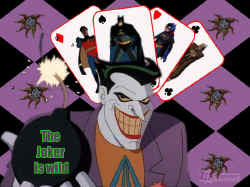
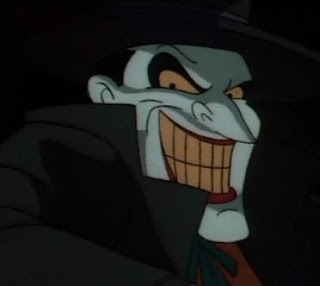
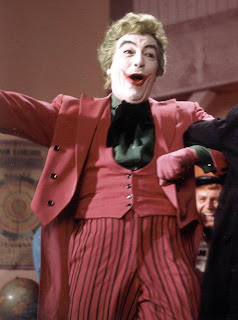
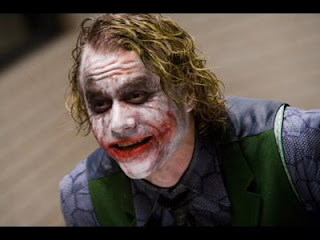
With a movie, well, as much as everyone wants to talk about how movies are now, basically, limitless, this is just not true. With live action, no one will be able to fully pull off the manic evil or the rictus grin of the Joker. In animation, well, you'd think it would be better, but sometimes still images still pack a more visceral punch than animation. Observe a two images from the most common animated Joker.
Now, a picture of Jack Nicolson, that other guy from the 60s and Heath Ledger as the Joker:

Here are some comic book versions of him:
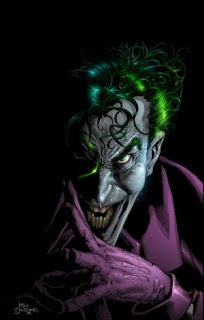

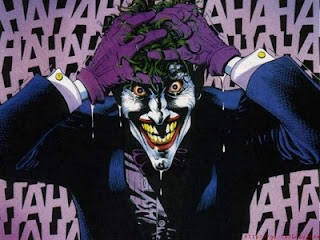
I think the comic book Joker comes out on top, and I can't think of how those images could be fully transferred to the screen. I'm not blasting the film or animated versions of Batman (although some of them, like Batman Returns, are pretty darn awful). But the source really is the best here.
Anyway, I really am getting into Batman. He's really cool for one thing, and a lot of his comics offer interesting themes. For example, in one of the classic Batman tales, "The Dark Knight Returns," Bruce Wayne comes out of retirement to be Batman in his later years. This book explores aging and feeling out of place, as well as satirizing political correctness and the endless "rehabilitating" of criminals. Oftentimes, comics will delve into the practicality and common sense of whether Batman's decision not to use lethal force is a good one.
Another reason I like Batman is that most of his villains are pretty iconic, and they aren't dumb or campy. For example, Superman's biggest villains are Lex Luthor (ok, so he's pretty cool), an alien, a "Superman" who does the opposite of him, a man made of Kryptonite and this funny looking interdimensional midget. Spiderman, while having a few cool villains, also has a guy that can turn into sand, a strong guy in a rhino suit, a guy made of water, etc. Also, most of his villains are the result of an industrial accident.
While some of Batman's villains are the result of an accident, most of his good villains aren't endowed with powers from their accidents, just creepy psychosis. For example, the Joker, while getting his creepy look from an industrial accident, is insane. He doesn't have some sort of "chemical power." Black Mask has a horribly scarred face, but he's not supernatural. Granted, Poison Ivy and Mr. Freeze both have accident specific abilities, but I will readily admit that Poison Ivy is not a good villain, and Mr. Freeze is a lot more scientific. He can't just shoot ice out of his hands.
I watched "Batman Begins" the other day. It was the first time I had seen it since I started reading the comics. While Begins is a good movie regardless of whether you have read the comics, I liked it even more because it stayed true to the spirit of the books in a way that the other movies don't even come close to. The entire point of Batman is that he strikes fear into the hearts of criminals. The Batman of the 90s movies isn't scary. Maybe a bit in the first movie, but if Michael Keaton prancing around in a Batsuit that can barely move is your hallmark of scariness, you have a problem. The Batman of Begins is a hero you could actually picture villains being scared of.
With comic book movies, you're more concerned that they stick to the spirit of the books. Some events should be kept too, but events are retconned in the comics so much that it's the spirit that's really important. Begins sticks to the spirit. I hope The Dark Knight will as well. Heath looks really, really scary as the Joker, which is good, but he doesn't look happy enough. When the Joker is battling Batman, he's in his element. He's incredibly, insanely happy. That's the unnerving thing about him. I hope they keep that.
Meanwhile, I'll still keep reading the books. I am trying to find some more comics with The Riddler, Two Face and The Penguin in them. It would be nice to find more with Mr. Freeze or Black Mask too. Poison Ivy and Catwoman? Meh.
Comics are really a new medium for me. It's kind of a cross between a movie and a book. In a book, the story is moved forward entirely in the reader's imagination. Obviously, the writer gives the reader signposts to base their imaginings on, but it really is up to you.
With movies, it's the opposite. Movies are purely the triumph of the filmmakers' imagination. We see all sorts of truly impressive things, but we're (for the most part) just taking in the creativity of other people.
Comics are a different format than both books and movies for two reasons. The first reason is that they feature a unique blend of showing you the action and letting you imagine the action.
They have plot exposition, but only enough to show you what's going on. You get the rest by reading the dialogue and--primarily--by looking at the artwork. They have fight scenes, but not enough panels to show you all the action. You get the entire scene in your head, with the artist showing you some of the most impressive frames. You see the fear in criminals minds, the menace of the evil masterminds, but it's up to you to fill in the backlog of escapades that have made each character so legendary.
The other difference is that, in some ways, comic books can be more visually expressive than either other medium. Granted, books truly are limitless. You can have a writer like Terry Pratchett, who has made up the color octarine, or you can have other writers who speak of multidimensional beings, but even these descriptions are limited by our imagination. Sure, we can read about octarine, but it is impossible for us to think of a color that we've never seen before, let alone one that doesn't exist. The other thing with books (and don't get me wrong, books are still my favorite medium, by far) is that the images that books create, while vivid, don't have any way of being viewed other than in our mind's eye. In a comic book, the writer, penciller and inker work together to show what their image was supposed to look like.
With a movie, well, as much as everyone wants to talk about how movies are now, basically, limitless, this is just not true. With live action, no one will be able to fully pull off the manic evil or the rictus grin of the Joker. In animation, well, you'd think it would be better, but sometimes still images still pack a more visceral punch than animation. Observe a two images from the most common animated Joker.


Now, a picture of Jack Nicolson, that other guy from the 60s and Heath Ledger as the Joker:


Here are some comic book versions of him:


I think the comic book Joker comes out on top, and I can't think of how those images could be fully transferred to the screen. I'm not blasting the film or animated versions of Batman (although some of them, like Batman Returns, are pretty darn awful). But the source really is the best here.
Anyway, I really am getting into Batman. He's really cool for one thing, and a lot of his comics offer interesting themes. For example, in one of the classic Batman tales, "The Dark Knight Returns," Bruce Wayne comes out of retirement to be Batman in his later years. This book explores aging and feeling out of place, as well as satirizing political correctness and the endless "rehabilitating" of criminals. Oftentimes, comics will delve into the practicality and common sense of whether Batman's decision not to use lethal force is a good one.
Another reason I like Batman is that most of his villains are pretty iconic, and they aren't dumb or campy. For example, Superman's biggest villains are Lex Luthor (ok, so he's pretty cool), an alien, a "Superman" who does the opposite of him, a man made of Kryptonite and this funny looking interdimensional midget. Spiderman, while having a few cool villains, also has a guy that can turn into sand, a strong guy in a rhino suit, a guy made of water, etc. Also, most of his villains are the result of an industrial accident.
While some of Batman's villains are the result of an accident, most of his good villains aren't endowed with powers from their accidents, just creepy psychosis. For example, the Joker, while getting his creepy look from an industrial accident, is insane. He doesn't have some sort of "chemical power." Black Mask has a horribly scarred face, but he's not supernatural. Granted, Poison Ivy and Mr. Freeze both have accident specific abilities, but I will readily admit that Poison Ivy is not a good villain, and Mr. Freeze is a lot more scientific. He can't just shoot ice out of his hands.
I watched "Batman Begins" the other day. It was the first time I had seen it since I started reading the comics. While Begins is a good movie regardless of whether you have read the comics, I liked it even more because it stayed true to the spirit of the books in a way that the other movies don't even come close to. The entire point of Batman is that he strikes fear into the hearts of criminals. The Batman of the 90s movies isn't scary. Maybe a bit in the first movie, but if Michael Keaton prancing around in a Batsuit that can barely move is your hallmark of scariness, you have a problem. The Batman of Begins is a hero you could actually picture villains being scared of.
With comic book movies, you're more concerned that they stick to the spirit of the books. Some events should be kept too, but events are retconned in the comics so much that it's the spirit that's really important. Begins sticks to the spirit. I hope The Dark Knight will as well. Heath looks really, really scary as the Joker, which is good, but he doesn't look happy enough. When the Joker is battling Batman, he's in his element. He's incredibly, insanely happy. That's the unnerving thing about him. I hope they keep that.
Meanwhile, I'll still keep reading the books. I am trying to find some more comics with The Riddler, Two Face and The Penguin in them. It would be nice to find more with Mr. Freeze or Black Mask too. Poison Ivy and Catwoman? Meh.
Subscribe to:
Posts (Atom)