I remember getting ready to watch the film version of "The Hitchhiker's Guide to the Galaxy" for the first time. I was excited. I was not nearly the fan that I am now (I had only read the first three, and I believe the first one was the only one I had read multiple times), but I was still eager to see one of my favorite books brought to the screen.
Sadly, I was disappointed.
The casting for Arthur and Ford was perfect (or, for fans of the books, "prefect." haha). The voices for Marvin and the guide are also great, and the Heart of Gold is good for some gags. Most of the rest of the movie, unfortunately, falls short. Trillian is boring, Zaphod is awful (and his two-headedness is not handled correctly at all) and neither the spirit nor the events of the books are respected. There are some nods here and there, but that's all.
Now while some TV shows, books or video games aren't really adaptable to the silver screen, Hitchhiker's could have been done very well. It has worked in book form, as a TV show, as a video game (sort of) and in its original format as a radio broadcast. The manic absurdity could translate quite well to the big screen. But, alas, it didn't. What a disappointment for Douglas Adam's fans.
All of that to say that film adaptations of other things are tricky. Let's look at few, shall we?
Comic books are a mixed bag. Lord of the Rings-some loved them, others didn't (I being among the latter group, for the most part). Narnia-the director seems to have trouble balancing adventure with truism to the books. The Bourne movies-Well, all 8 fans of those books were probably disappointed. Dudley DoRight? Ugh. George of the Jungle? I haven't seen it, but I've heard ugh. Rocky and Bullwinkle? Well, I actually liked that one. As a fan of the show and of the movie, I liked that the goofball awful pun plot contrivance spirit of the show carried over. However, the point remains. When you make a film adaptation, someone is going to complain.
Get Smart would seem to be a perfect candidate for a film adaptation. There's slapstick, wordplay, funny gadgets and appeal to multiple age groups. Plus, it has Steve Carell, who can make almost anything funny, Anne Hathaway, The Rock, Alan Arkin and other stars. It could a be a film that's fun for the whole family. Right?
Shoulda woulda coulda, unfortunately. The plot sounds fun enough: Agent Maxwell Smart is promoted after all of the other agents' covers are blown. He and the one remaining covert agent go to Russia to find nuclear weapons held by terrorists. Max is betrayed, escapes, and foils the nuclear attack on the President (although the movie seems to indicate that if the President is Bush, death by radioactive explosion might not be so bad. More on that later). If any of that is a spoiler to you, you probably were expecting a completely different movie altogether.
The most unfortunate part is that Steve Carell does a great job, and the other actors do well too. There's even a quite funny cameo by Bill Murray. The writers, too, unearth a few gems in their screenplay (including a few genuinely funny show references, a sly remark about the self-importance of actors and a few other clever, unexpected jokes). However, when I say unearth, there's something the writers were unearthing it from.
A lot of reviewers are giving this film lower marks because they feel like it's uneven. They feel that the action scenes and some of the violence don't always mesh with the quirky comedy. I disagree. I think that the action works with the comedy, kind of because there are jokes thrown into the fight scenes so it's not action scene/comic scene/action scene/comic scene the entire movie. However, I did feel that the film was uneven.
Now, this is the point where, if my mom ever reads this, she will purse her lips slightly with mild, concerning disapproval (I really do appreciate your concern, Mom). I don't mind all sexual jokes. I occasionally tell sexual jokes. They can be funny if they aren't disgusting and if the movie isn't in love with them. But they can also be unfunny and stupid. This is what happened a lot of the time during this movie.
Whenever the movie was about to get into a comedic groove, the writers would throw in a couple of uncreative sexual jokes, including a homosexual sight gag that no one needed to see. In addition to this, the camera very annoyingly seems to find new angles and ways to ogle Anne Hathaway's body. She knows it too. You can tell just by subtle facial expressions that she gets when she thrusts out her chest during a dance or bares most of her leg; she's totally thinking, "Yeeeeah, I'm sexy. Get some." And it detracts from the film.
The other thing that I thought was stupid, and this is more just an aside about the movie biz in general, is the movie's "political satire" of George Bush. Don't get me wrong, satirizing politicians can be really funny. But this wasn't funny. Nor was it satire. The one bit of satire (the President reading books to kids in a library) is rather displaced, and it's not really even amusing. The rest of it, which includes the President falling asleep during a concert, the President laughing at a conductor getting tackled and the President taking juvenile joy in a man's exposed butt, isn't satire, nor is it something that ANYone hasn't seen before. Seriously, this is one of the oldest shticks that is still popular in Hollywood, and it needs to end. It reminded me of (the bad movie) Transformers, where the President has a southern accent and wants to eat some ding dongs, and this is satire somehow. Except not at all.
Overall, it was a moderately funny movie with some annoying persistent stupid gags. I'd watch it again, but not for a good amount of time.
Friday, June 20, 2008


Tuesday, June 17, 2008
Beatle Blog - Revolver
"Revolver" is the first of the "later era" Beatles albums and it was a crossroads for the band: after tinkering with new musical sounds on their last effort, "Rubber Soul," The Fab Four began to really dig deep on Revolver, culminating in their months-long recording and mixing of their tour de force next album, "Sgt. Pepper's Lonely Hearts Club Band." Revolver was a transition, not only for them, but for the music world. It was one of the first albums in which a band cared as much about the musical composition of the album as they did about touring.
As I said in my review of "Help!," albums were things that were made so that they could be sold at concerts. They weren't nearly as musically important as they are now. People didn't put nearly as much time into them. "Please Please Me," the Beatles' first album, was recorded in a single day. The album was about rock and roll alone. Musical innovation was saved for later.
So, how did this album make music history? Well now...
Let's start with the drugs. While many point to Sgt. Pepper's as the Beatles' obligatory drug-induced album, I would point to Revolver as the album in which drugs played a more influential role. Consider that Sgt. Pepper had one song that was about pot ("Fixing a Hole") that might have been (although the band denied it) about LSD, with a few rumored drug references in some of the other songs.
Revolver, on the other hand, has four songs that are about or directly inspired by drugs of different kinds ("She Said, She Said," "Tomorrow Never Knows," "Got To Get You Into My Life" and "Dr. Robert"). Once again, the Beatles helped usher a new musical element-the drug song-into the mainstream musical consciousness.
That wasn't the only druggy part of the album, either. One night, while Paul was significantly stoned, he accidentally threaded some tape backwards and was giddily delighted to discover the odd and frenetic sounds that came out of his tape player. Thus, backmasking, recording some of the elements of a song backwards, was born. Backmasking has been a huge element in recording since the time of Revolver, so I guess we have pot to thank for it.
Another huge innovation that appeared for the first time on this album was double tracking voices. Previously, if you wanted your voice to be accompanied or echoed a little by the same voice, you would have to record an entirely new track to do so. New technology allowed the Beatles to simply layer their voices over, saving lots of time and helping to enrich the musical atmosphere. Enough about how groundbreaking this stuff was though, let's get to the music.
The album starts out a rockin' tune: the first George Harrison track to be really good, Taxman. This was as close to political as the band ever got, with Harrison complaining about how both sides of the political aisle are responsible for oppressively high taxes. The lyrics are witty, but the highlight of the track is a blistering guitar riff by Paul McCartney.
The Beatles were foraying across all kind of musical territory with this release, and they followed up the rocky Taxman with the urgent, string laden ballad "Eleanor Rigby." This was one of their #1 singles, and it's one of the saddest songs in the Beatles' catalog.
The third track, "I'm Only Sleeping," was one of the songs in which musical innovation played a key role. In order to get a wispy, dreamlike feel for the song, the band supplemented the casual bassline and light drumming with a guitar solo by Harrison. The twist? Harrison practiced playing the solo backwards, and he recorded it backwards onto a forward recording tape. He then rethreaded the tape so that the tape was playing backwards, thus playing the guitar solo forwards yet giving it an altogether different sound. It works, too.
After I'm Only Sleeping comes "Love You To," one of George's more unfortunate attempts to sound Indian, and "Here, There, and Everywhere," one of Paul's more popular melodic pieces. Now, before I go any further, let me say a brief word about what might be the Beatles' most maligned track, "Yellow Submarine."
First of all, the song is meant to be a nursery rhyme. John and Paul wrote it as such, and they wrote it for Ringo to sing, which explains the voice. So, while to criticize it as a normal song is unfair, it actually holds up rather well in musical complexity. Laden with submarine clips and a bridge with a nautically-placed on-board conversation, the song also conveys its party atmosphere quite well, with a large, raucous, laughing chorus to sing the last part of the song. So don't be hating on the Beatles because of this song. That would, quite honestly, be a bit ignorant of you.
Following Yellow Submarine is "She Said, She Said," a song that Lennon wrote about an experience during a bad trip. It has one of Ringo's more admired drum tracks on it, providing an atmospheric shell to the song, while the guitar riffs echo the vocal lines.
After this, we enter the "Paul is really awesome" section of the album with "Good Day Sunshine." While the chorus is repeated a bit too much, his cheerful, upbeat voice and one of the happiest pianos you'll ever hear combine to make a song you can't help but be charmed by. After this is "And Your Bird Can Sing," a John song with a really good guitar riff and energetic vocals.
Paul hits you with some more awesome on "For No One," a song with piano and string bits emphasizing the beautifully sad vocals. It used to bother me that this song ends relatively abruptly, but I think that perhaps Paul meant it to sound that way. It seems to mirror the lyrics, about a love that was cut off too soon.
"Dr. Robert" follows For No One. It's a standard rock song, not a lot standing out. After that is George's "I Want to Tell You," which is pretty interesting. The song is about how George has trouble expressing himself in words to people. While the lyrics are rather simplistic, the most noticeable part of the song is a few notes played repetitively throughout the piece. They are mildly dissonant the entire time, making the listener uncomfortable and allowing George's point about his verbal discomfort to be illustrated aurally. It's a good effect.
Now we come to the album's standout track, Paul's "Got To Get You Into My Life," an ode to marijuana (although its vagueness initially led some to believe it was a love song). Paul styled this album in the ways of the Motown and soul genres, and the main instruments on the track are horns. The star of the track is Paul's voice, however, as he tears through this track with some of his best reaches in any of the Fab Four's albums. This is a must-hear.
The album ends with an odd, yet influential, John creation: "Tomorrow Never Knows." Not content with inventing world music on Rubber Soul and backmasking on this album, John decides here to invent psychedelic music. Inspired by LSD and the Tibetan Book of the Dead, John created this trippy song's lyrics. The music, however, was supplied by all of the members. While it is notable for Ringo's drumming, which fits the song while somehow being separate from it, it is most noted for two musical innovations: tape loops and the echo on John's voice.
Paul discovered that a weird saturation effect occurred when you messed with tape loops in a certain way. The loops kept on running over themselves, giving anything you recorded an infinite loop sound. The band looped several different instruments and sounds, then edited them before putting them into the song. The sounds make for a distinct, surreal atmosphere.
The voice came from John's desire to sound like a monk singing from a mountaintop. He told his producer, George Martin, that perhaps they could hang him by a rope from the studio ceiling and then swing him around the microphone. Martin wisely nixed this idea, telling John he'd look into it. What they ended up doing was routing John's voice through a Leslie speaker cabinet, a speaker usually used for the vibrato electric organs heard on so many 60s rock tracks. The vibrato is transferred to his voice.
In short, Revolver is one of the most influential albums of all time. It is ranked as the number one album of all time by some music sources, and it is home to some of the Beatles' best work.
What it did for the Beatles: Helped George emerge more as a songwriter, established their desire to make truly innovative studio work, started their psychedelic phase, established the artistic freedom they needed to make Sgt. Pepper, etc.
What it did for the music world: Hard to overemphasize this. Introduced backmasking, one of the first psychedelically-tinged albums, showed nearly unprecedented craftsmanship in album-making, introduced double tracking and editing voice through Leslie speakers, probably some other stuff that I don't know. Seriously folks, this is a big one.
Album Highlights: Taxman, Eleanor Rigby, Good Day Sunshine, And Your Bird Can Sing, For No One, Got To Get You Into My Life, Tomorrow Never Knows. Yes, I know that that's half of the album.
Ryan's Beatle Ranking: #3 out of 12, just behind Sgt. Pepper's and Abby Road.
Next on Blogging the Beatles: Rubber Soul
As I said in my review of "Help!," albums were things that were made so that they could be sold at concerts. They weren't nearly as musically important as they are now. People didn't put nearly as much time into them. "Please Please Me," the Beatles' first album, was recorded in a single day. The album was about rock and roll alone. Musical innovation was saved for later.
So, how did this album make music history? Well now...
Let's start with the drugs. While many point to Sgt. Pepper's as the Beatles' obligatory drug-induced album, I would point to Revolver as the album in which drugs played a more influential role. Consider that Sgt. Pepper had one song that was about pot ("Fixing a Hole") that might have been (although the band denied it) about LSD, with a few rumored drug references in some of the other songs.
Revolver, on the other hand, has four songs that are about or directly inspired by drugs of different kinds ("She Said, She Said," "Tomorrow Never Knows," "Got To Get You Into My Life" and "Dr. Robert"). Once again, the Beatles helped usher a new musical element-the drug song-into the mainstream musical consciousness.
That wasn't the only druggy part of the album, either. One night, while Paul was significantly stoned, he accidentally threaded some tape backwards and was giddily delighted to discover the odd and frenetic sounds that came out of his tape player. Thus, backmasking, recording some of the elements of a song backwards, was born. Backmasking has been a huge element in recording since the time of Revolver, so I guess we have pot to thank for it.
Another huge innovation that appeared for the first time on this album was double tracking voices. Previously, if you wanted your voice to be accompanied or echoed a little by the same voice, you would have to record an entirely new track to do so. New technology allowed the Beatles to simply layer their voices over, saving lots of time and helping to enrich the musical atmosphere. Enough about how groundbreaking this stuff was though, let's get to the music.
The album starts out a rockin' tune: the first George Harrison track to be really good, Taxman. This was as close to political as the band ever got, with Harrison complaining about how both sides of the political aisle are responsible for oppressively high taxes. The lyrics are witty, but the highlight of the track is a blistering guitar riff by Paul McCartney.
The Beatles were foraying across all kind of musical territory with this release, and they followed up the rocky Taxman with the urgent, string laden ballad "Eleanor Rigby." This was one of their #1 singles, and it's one of the saddest songs in the Beatles' catalog.
The third track, "I'm Only Sleeping," was one of the songs in which musical innovation played a key role. In order to get a wispy, dreamlike feel for the song, the band supplemented the casual bassline and light drumming with a guitar solo by Harrison. The twist? Harrison practiced playing the solo backwards, and he recorded it backwards onto a forward recording tape. He then rethreaded the tape so that the tape was playing backwards, thus playing the guitar solo forwards yet giving it an altogether different sound. It works, too.
After I'm Only Sleeping comes "Love You To," one of George's more unfortunate attempts to sound Indian, and "Here, There, and Everywhere," one of Paul's more popular melodic pieces. Now, before I go any further, let me say a brief word about what might be the Beatles' most maligned track, "Yellow Submarine."
First of all, the song is meant to be a nursery rhyme. John and Paul wrote it as such, and they wrote it for Ringo to sing, which explains the voice. So, while to criticize it as a normal song is unfair, it actually holds up rather well in musical complexity. Laden with submarine clips and a bridge with a nautically-placed on-board conversation, the song also conveys its party atmosphere quite well, with a large, raucous, laughing chorus to sing the last part of the song. So don't be hating on the Beatles because of this song. That would, quite honestly, be a bit ignorant of you.
Following Yellow Submarine is "She Said, She Said," a song that Lennon wrote about an experience during a bad trip. It has one of Ringo's more admired drum tracks on it, providing an atmospheric shell to the song, while the guitar riffs echo the vocal lines.
After this, we enter the "Paul is really awesome" section of the album with "Good Day Sunshine." While the chorus is repeated a bit too much, his cheerful, upbeat voice and one of the happiest pianos you'll ever hear combine to make a song you can't help but be charmed by. After this is "And Your Bird Can Sing," a John song with a really good guitar riff and energetic vocals.
Paul hits you with some more awesome on "For No One," a song with piano and string bits emphasizing the beautifully sad vocals. It used to bother me that this song ends relatively abruptly, but I think that perhaps Paul meant it to sound that way. It seems to mirror the lyrics, about a love that was cut off too soon.
"Dr. Robert" follows For No One. It's a standard rock song, not a lot standing out. After that is George's "I Want to Tell You," which is pretty interesting. The song is about how George has trouble expressing himself in words to people. While the lyrics are rather simplistic, the most noticeable part of the song is a few notes played repetitively throughout the piece. They are mildly dissonant the entire time, making the listener uncomfortable and allowing George's point about his verbal discomfort to be illustrated aurally. It's a good effect.
Now we come to the album's standout track, Paul's "Got To Get You Into My Life," an ode to marijuana (although its vagueness initially led some to believe it was a love song). Paul styled this album in the ways of the Motown and soul genres, and the main instruments on the track are horns. The star of the track is Paul's voice, however, as he tears through this track with some of his best reaches in any of the Fab Four's albums. This is a must-hear.
The album ends with an odd, yet influential, John creation: "Tomorrow Never Knows." Not content with inventing world music on Rubber Soul and backmasking on this album, John decides here to invent psychedelic music. Inspired by LSD and the Tibetan Book of the Dead, John created this trippy song's lyrics. The music, however, was supplied by all of the members. While it is notable for Ringo's drumming, which fits the song while somehow being separate from it, it is most noted for two musical innovations: tape loops and the echo on John's voice.
Paul discovered that a weird saturation effect occurred when you messed with tape loops in a certain way. The loops kept on running over themselves, giving anything you recorded an infinite loop sound. The band looped several different instruments and sounds, then edited them before putting them into the song. The sounds make for a distinct, surreal atmosphere.
The voice came from John's desire to sound like a monk singing from a mountaintop. He told his producer, George Martin, that perhaps they could hang him by a rope from the studio ceiling and then swing him around the microphone. Martin wisely nixed this idea, telling John he'd look into it. What they ended up doing was routing John's voice through a Leslie speaker cabinet, a speaker usually used for the vibrato electric organs heard on so many 60s rock tracks. The vibrato is transferred to his voice.
In short, Revolver is one of the most influential albums of all time. It is ranked as the number one album of all time by some music sources, and it is home to some of the Beatles' best work.
What it did for the Beatles: Helped George emerge more as a songwriter, established their desire to make truly innovative studio work, started their psychedelic phase, established the artistic freedom they needed to make Sgt. Pepper, etc.
What it did for the music world: Hard to overemphasize this. Introduced backmasking, one of the first psychedelically-tinged albums, showed nearly unprecedented craftsmanship in album-making, introduced double tracking and editing voice through Leslie speakers, probably some other stuff that I don't know. Seriously folks, this is a big one.
Album Highlights: Taxman, Eleanor Rigby, Good Day Sunshine, And Your Bird Can Sing, For No One, Got To Get You Into My Life, Tomorrow Never Knows. Yes, I know that that's half of the album.
Ryan's Beatle Ranking: #3 out of 12, just behind Sgt. Pepper's and Abby Road.
Next on Blogging the Beatles: Rubber Soul
Wednesday, June 11, 2008
What a super list!
All that talk about comic books and superheroes got me thinking about super hero movies. Thus, I have compiled a list of my top ten comic book/superhero movies. Keep in mind that I have not seen every superhero/comic book movie, so if you are sad that:
Either Fantastic 4 movie
The Punisher
The old Superman flicks
The old Captain America flicks
Either Hulk
Sin City
Supergirl
Men in Black II
A History of Violence
V for Vendetta
The League of Extraordinary Gentlemen
Daredevil
Elektra
My criteria for this list was that the movie had to be either based on a comic book or done in a comic book style, and it should contain adventure action (so, no Garfield. Sorry folks).
A good comic book story has lots of neat action, but it also has a good story and themes to think about. However, as you'll see from my list, some of the best comic book movies that have been adapted don't accomplish this all of the time. Comic books have been an often-mined-yet-not-done-incredibly-well genre up until the last few years. I think there have been strides made as of late, but the industry has a way to go. Here's my list.
Ok, so I'll admit it, my first entry on this list completely negates my good plot, good action bit in the above paragraph, but that's ok with me. Here's why I like this movie when everyone else hates it: it's a spoof. There is no way a movie that is this absurd can't be a spoof. While there is a light mocking of Batman through the ages that pops up all over the film, it's primarily concerned with mocking the Batman TV show. The campy lines, the wonderfully impractical gadgets, the implausible and over-the-top villains. All of that is ripped right off of the TV show and put to a more modern skewering. The funny thing is that the TV show (and the TV show movie, which is good in its own way) was skewering the original comics. People complain that some people view Batman as a joke because of the show, but the oldest strips weren't fearsome. They were amusingly silly stories and horribly expositionary dialogue. The show just riffed on it, and Batman & Robin riffs on the show. Plus, how can you not like Mr. Freeze? "Let's kick some ice!"
The X-Men series is incredibly uneven, but the first one I liked well enough to want to continue watching. Mostly because of Magneto. Magneto is one of the best villains in any superhero movie. He's cold, vengeful and motivated, but he can show his human side when he wants to. Thus, while I wasn't big on some of the other X-Men in this film (read: Sabretooth and Toad), there were enough cool things and a good enough plot to keep it interesting. Favorite part: Magneto blatantly ignoring the laws of magnetism by controlling bullets.
I know, I know. This isn't a superhero movie. However, it is based on a comic book, and there are cool gadgets and stuff, and they do heroic things. So, it's kind of like a wise-cracking Batman. Oh wait, that's Iron Man. But still.
7. Spiderman
6. Superman Returns
5. Spiderman 2
4. Iron Man
3. The Incredibles
Not a comic book, but an homage to several and done in the style of a good one. Besides, I hear that the movie is more faithful in some aspects to The Fantastic 4 than the actual movie was. Great dialogue, great story, great villain.
2. X2: X-Men United
This is by far the best out of the three X-Men movies. The story is complex and engaging, the villains are, well, Magneto, the action is good and the acting is the best of the series. Good stuff. Favorite part: "Too much iron in your blood" and the aftermath.
1. Batman Begins
Excellent themes, engaging and twisting plot, true to the comic books, believable (for a comic book movie), action-packed and gripping. Batman is great hero, and this movie finally does him justice.
Comic sans ridicule
So, at the end of this last school year, I started reading comic books. I have, as I'm sure most of you have, seen many comic book superhero movies, and I wanted to see what was behind the inspiration for these movies. I wanted to immerse myself in just one title, so I could really get into the stories, so, after some research to decide which comic book series sounded the coolest (yes, I did comic book research. Yes, I'm a nerd), I picked Batman. And I am now slightly addicted.
Comics are really a new medium for me. It's kind of a cross between a movie and a book. In a book, the story is moved forward entirely in the reader's imagination. Obviously, the writer gives the reader signposts to base their imaginings on, but it really is up to you.
With movies, it's the opposite. Movies are purely the triumph of the filmmakers' imagination. We see all sorts of truly impressive things, but we're (for the most part) just taking in the creativity of other people.
Comics are a different format than both books and movies for two reasons. The first reason is that they feature a unique blend of showing you the action and letting you imagine the action.
They have plot exposition, but only enough to show you what's going on. You get the rest by reading the dialogue and--primarily--by looking at the artwork. They have fight scenes, but not enough panels to show you all the action. You get the entire scene in your head, with the artist showing you some of the most impressive frames. You see the fear in criminals minds, the menace of the evil masterminds, but it's up to you to fill in the backlog of escapades that have made each character so legendary.
The other difference is that, in some ways, comic books can be more visually expressive than either other medium. Granted, books truly are limitless. You can have a writer like Terry Pratchett, who has made up the color octarine, or you can have other writers who speak of multidimensional beings, but even these descriptions are limited by our imagination. Sure, we can read about octarine, but it is impossible for us to think of a color that we've never seen before, let alone one that doesn't exist. The other thing with books (and don't get me wrong, books are still my favorite medium, by far) is that the images that books create, while vivid, don't have any way of being viewed other than in our mind's eye. In a comic book, the writer, penciller and inker work together to show what their image was supposed to look like.
With a movie, well, as much as everyone wants to talk about how movies are now, basically, limitless, this is just not true. With live action, no one will be able to fully pull off the manic evil or the rictus grin of the Joker. In animation, well, you'd think it would be better, but sometimes still images still pack a more visceral punch than animation. Observe a two images from the most common animated Joker.
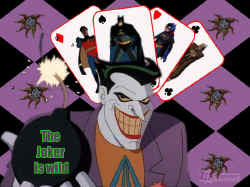
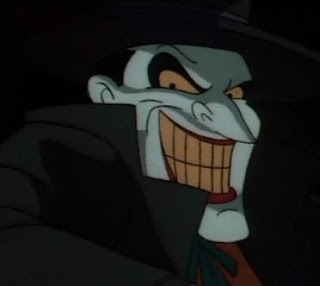
Now, a picture of Jack Nicolson, that other guy from the 60s and Heath Ledger as the Joker:

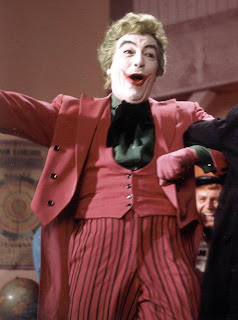
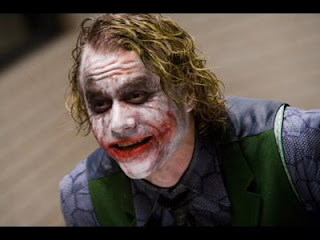
Here are some comic book versions of him:
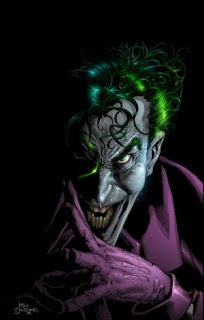

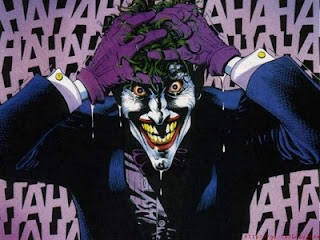
I think the comic book Joker comes out on top, and I can't think of how those images could be fully transferred to the screen. I'm not blasting the film or animated versions of Batman (although some of them, like Batman Returns, are pretty darn awful). But the source really is the best here.
Anyway, I really am getting into Batman. He's really cool for one thing, and a lot of his comics offer interesting themes. For example, in one of the classic Batman tales, "The Dark Knight Returns," Bruce Wayne comes out of retirement to be Batman in his later years. This book explores aging and feeling out of place, as well as satirizing political correctness and the endless "rehabilitating" of criminals. Oftentimes, comics will delve into the practicality and common sense of whether Batman's decision not to use lethal force is a good one.
Another reason I like Batman is that most of his villains are pretty iconic, and they aren't dumb or campy. For example, Superman's biggest villains are Lex Luthor (ok, so he's pretty cool), an alien, a "Superman" who does the opposite of him, a man made of Kryptonite and this funny looking interdimensional midget. Spiderman, while having a few cool villains, also has a guy that can turn into sand, a strong guy in a rhino suit, a guy made of water, etc. Also, most of his villains are the result of an industrial accident.
While some of Batman's villains are the result of an accident, most of his good villains aren't endowed with powers from their accidents, just creepy psychosis. For example, the Joker, while getting his creepy look from an industrial accident, is insane. He doesn't have some sort of "chemical power." Black Mask has a horribly scarred face, but he's not supernatural. Granted, Poison Ivy and Mr. Freeze both have accident specific abilities, but I will readily admit that Poison Ivy is not a good villain, and Mr. Freeze is a lot more scientific. He can't just shoot ice out of his hands.
I watched "Batman Begins" the other day. It was the first time I had seen it since I started reading the comics. While Begins is a good movie regardless of whether you have read the comics, I liked it even more because it stayed true to the spirit of the books in a way that the other movies don't even come close to. The entire point of Batman is that he strikes fear into the hearts of criminals. The Batman of the 90s movies isn't scary. Maybe a bit in the first movie, but if Michael Keaton prancing around in a Batsuit that can barely move is your hallmark of scariness, you have a problem. The Batman of Begins is a hero you could actually picture villains being scared of.
With comic book movies, you're more concerned that they stick to the spirit of the books. Some events should be kept too, but events are retconned in the comics so much that it's the spirit that's really important. Begins sticks to the spirit. I hope The Dark Knight will as well. Heath looks really, really scary as the Joker, which is good, but he doesn't look happy enough. When the Joker is battling Batman, he's in his element. He's incredibly, insanely happy. That's the unnerving thing about him. I hope they keep that.
Meanwhile, I'll still keep reading the books. I am trying to find some more comics with The Riddler, Two Face and The Penguin in them. It would be nice to find more with Mr. Freeze or Black Mask too. Poison Ivy and Catwoman? Meh.
Comics are really a new medium for me. It's kind of a cross between a movie and a book. In a book, the story is moved forward entirely in the reader's imagination. Obviously, the writer gives the reader signposts to base their imaginings on, but it really is up to you.
With movies, it's the opposite. Movies are purely the triumph of the filmmakers' imagination. We see all sorts of truly impressive things, but we're (for the most part) just taking in the creativity of other people.
Comics are a different format than both books and movies for two reasons. The first reason is that they feature a unique blend of showing you the action and letting you imagine the action.
They have plot exposition, but only enough to show you what's going on. You get the rest by reading the dialogue and--primarily--by looking at the artwork. They have fight scenes, but not enough panels to show you all the action. You get the entire scene in your head, with the artist showing you some of the most impressive frames. You see the fear in criminals minds, the menace of the evil masterminds, but it's up to you to fill in the backlog of escapades that have made each character so legendary.
The other difference is that, in some ways, comic books can be more visually expressive than either other medium. Granted, books truly are limitless. You can have a writer like Terry Pratchett, who has made up the color octarine, or you can have other writers who speak of multidimensional beings, but even these descriptions are limited by our imagination. Sure, we can read about octarine, but it is impossible for us to think of a color that we've never seen before, let alone one that doesn't exist. The other thing with books (and don't get me wrong, books are still my favorite medium, by far) is that the images that books create, while vivid, don't have any way of being viewed other than in our mind's eye. In a comic book, the writer, penciller and inker work together to show what their image was supposed to look like.
With a movie, well, as much as everyone wants to talk about how movies are now, basically, limitless, this is just not true. With live action, no one will be able to fully pull off the manic evil or the rictus grin of the Joker. In animation, well, you'd think it would be better, but sometimes still images still pack a more visceral punch than animation. Observe a two images from the most common animated Joker.


Now, a picture of Jack Nicolson, that other guy from the 60s and Heath Ledger as the Joker:


Here are some comic book versions of him:


I think the comic book Joker comes out on top, and I can't think of how those images could be fully transferred to the screen. I'm not blasting the film or animated versions of Batman (although some of them, like Batman Returns, are pretty darn awful). But the source really is the best here.
Anyway, I really am getting into Batman. He's really cool for one thing, and a lot of his comics offer interesting themes. For example, in one of the classic Batman tales, "The Dark Knight Returns," Bruce Wayne comes out of retirement to be Batman in his later years. This book explores aging and feeling out of place, as well as satirizing political correctness and the endless "rehabilitating" of criminals. Oftentimes, comics will delve into the practicality and common sense of whether Batman's decision not to use lethal force is a good one.
Another reason I like Batman is that most of his villains are pretty iconic, and they aren't dumb or campy. For example, Superman's biggest villains are Lex Luthor (ok, so he's pretty cool), an alien, a "Superman" who does the opposite of him, a man made of Kryptonite and this funny looking interdimensional midget. Spiderman, while having a few cool villains, also has a guy that can turn into sand, a strong guy in a rhino suit, a guy made of water, etc. Also, most of his villains are the result of an industrial accident.
While some of Batman's villains are the result of an accident, most of his good villains aren't endowed with powers from their accidents, just creepy psychosis. For example, the Joker, while getting his creepy look from an industrial accident, is insane. He doesn't have some sort of "chemical power." Black Mask has a horribly scarred face, but he's not supernatural. Granted, Poison Ivy and Mr. Freeze both have accident specific abilities, but I will readily admit that Poison Ivy is not a good villain, and Mr. Freeze is a lot more scientific. He can't just shoot ice out of his hands.
I watched "Batman Begins" the other day. It was the first time I had seen it since I started reading the comics. While Begins is a good movie regardless of whether you have read the comics, I liked it even more because it stayed true to the spirit of the books in a way that the other movies don't even come close to. The entire point of Batman is that he strikes fear into the hearts of criminals. The Batman of the 90s movies isn't scary. Maybe a bit in the first movie, but if Michael Keaton prancing around in a Batsuit that can barely move is your hallmark of scariness, you have a problem. The Batman of Begins is a hero you could actually picture villains being scared of.
With comic book movies, you're more concerned that they stick to the spirit of the books. Some events should be kept too, but events are retconned in the comics so much that it's the spirit that's really important. Begins sticks to the spirit. I hope The Dark Knight will as well. Heath looks really, really scary as the Joker, which is good, but he doesn't look happy enough. When the Joker is battling Batman, he's in his element. He's incredibly, insanely happy. That's the unnerving thing about him. I hope they keep that.
Meanwhile, I'll still keep reading the books. I am trying to find some more comics with The Riddler, Two Face and The Penguin in them. It would be nice to find more with Mr. Freeze or Black Mask too. Poison Ivy and Catwoman? Meh.
Tuesday, June 3, 2008
Beatle Blog: Help!
I like to split the Beatles albums (they made 12 - not counting the Yellow Submarine soundtrack, which they barely contributed to - 12 albums in seven years!) into early albums and later albums. Since 12 is a good even number, I split them between their sixth album, "Rubber Soul," and their seventh album, "Revolver." The early albums, while still mostly excellent, reflected the current musical thinking of the time, namely that, rather than the main focus of the band, albums were things that you put out in between tours. It seems odd now, but that's basically what albums were back then: catchy promotional material.
Perhaps "Help!" was even more of a promotional album, considering that half of the songs from the album were from the Beatles' movie of the same name. The movie is pretty funny, basing much of its comedy on what made their first movie so popular: Ringo Starr both looks and sounds funny. This apparently never bothered him, and jokes about his nose appear in both flicks (their next movie was the critically-panned "Magical Mystery Tour").
Even so, for promotional material, no one was better than the Beatles. This is one of my favorite albums from their early work.
The album is influenced a bit by the songwriting and musical stylings of Bob Dylan. While I don't really like Bob ("HA duz eet feeull?") because of his absolutely horrendous singing voice, he is a good musician and an ok songwriter, so the influences are welcome on this album. It should be noted that Dylan also introduced the band to pot, which led to all sorts of other drugs (not to mention caused them to often forget their lines during the filming of the Help! movie).
The album opens with the title track, which has a very energetic beginning with some strong bass notes before getting into the rest of the song, which is upbeat folk-rock in nature. This characterizes a lot of Help!, actually, as it often contains jangly tambourine percussion and upbeat acoustic guitar, laced with some subtle vocal harmonies in the chorus. It also contains some of John's best songwriting. The title track is an autobiographical song about John losing control of his life, and he bangs out a few other good tunes on this album as well.
The beginning of the album really is great, as track two is "The Night Before" by Paul McCartney. Paul's vocal range really is astounding at times, and this song showcases it well. This song is also very upbeat, with an energetic bassline and a small electric guitar solo by George.
John is up again with the Dylanesque "You've Got to Hide Your Love Away," which is mostly just John playing the guitar with a tambourine in the background. It's very good, however, with John making his voice a bit more forlorn and shouting "Hey!" into the mic during every chorus. This one will get stuck in your head.
The Beatles, while sometimes behaving like jerks to outsiders, usually protected each other and made musical concessions to all of the members. As such, on most of their early albums, John and Paul would let George write and sing a few songs (even though they didn't think much of his songwriting ability), and they would write or pick a song for Ringo to sing. Ringo has an odd nasally sounding voice, but it usually suits the music he sings. Not so on Help!, as he sings lead on a cover of "Act Naturally." This song forced Ringo to go a lot higher than he usually does, resulting in a slightly off-key, shrill sounding song (as much as a nasally deep voice can be shrill). George's first lyrical contribution is also not too great on this album, with "I Need You" feeling slow and unoriginal.
I Need You is followed by "Another Girl," an catchy enough song by Paul with just enough flourish on the electric guitar to keep it interesting.
One interesting facet of the Beatles' early work is that, while they do show skill in their instrumentation, the instrumentation often takes a back seat to their vocal abilities, which are very, very good (this swung the opposite way once they made "Revolver"). This album often shows symptoms of this, with electric guitar flourishes and vocal acrobatics being the only "finishing touches" put on a basic rhythm track, like on Lennon's "You're Going to Lose that Girl." However, the vocals are so good that the song is still fun to hear.
After the aforementioned song, one of the Beatles' #1 singles, "Ticket to Ride," is on the docket. While not one of my favorite singles, it has a fun bass line and it's catchy.
After a few rather inconsequential songs, the back end of the album really shines. First, there is the obviously folk-influenced "Tell Me What You See," with some fun electric piano fills. There is also some really neat extra percussion used in this song. Then, well...
Sometimes, when I listen to a Beatles album, I am overcome by an "Oh-my-gosh-Paul-McCartney-is-so-awesome" moment. This happens every time I hear "I've Just Seen a Face," one of Paul's best compositions. It's a pretty simple track, containing just minimal percussion and three acoustic guitars (George's was a 12-string, but I'll save discussion of that for "Hard Day's Night"). But simplicity in this case is musical genius, as Paul expresses his excitement over falling for a new girl. He speeds through the lyrics and the guitars run along with him, giving the track an enthusiastic optimism that one is hard pressed to find anywhere in music.
After this song, well, there's this little ballad that is probably the most popular song in the entire world, ever. And no, I'm not exaggerating. According to wikipedia, Paul's "Yesterday" is the most covered song in the entire world, boasting over 3,000 different recordings. Read that again. Three. Thousand. Recordings. The song was the most played song on American radio for eight years. Possibly the most ironic thing is that the other Beatles didn't really like the song, feeling that a sentimental ballad went against their style. The song is quite beautiful, consisting solely of Paul playing a melancholy acoustic guitar and singing, with his beautiful voice, about the girl who left him. He is accompanied by a string quartet.
The album finishes up with a fun cover, "Dizzy Miss Lizzie."
Analysis: Overall, this album is the Beatles' fun, catchy tribute to folk-rock. It also contains a lot of their iconic early years material. The cohesive style holds the rollicking, sunny album together, and the tunes will surely be fighting for space in your head. Definitely check this one out.
What it did for the Beatles: Well, since "Yesterday" gained prominence as a single, not as a song on this album, this album mostly served to promote their movie and their new single, Help!
What it did for the music world: Folk was not a very popular genre in the early 60s (this album came out in 1965), which is not unsurprising when you consider that the king of folk at the time was Bob Dylan, who people enjoy now but honestly sounds as if a cheese grater is being yanked over his vocal cords. Groups like The Lovin' Spoonful; Peter, Paul, and Mary; the Mamas and the Papas and (with this album) the Beatles helped to make folk more palatable to the public.
Album Highlights: Help!, You've Got to Hide Your Love Away, I've Just Seen a Face, Yesterday
Ryan's Beatle ranking: #7 out of 12
Next on Blogging the Beatles: Revolver
Perhaps "Help!" was even more of a promotional album, considering that half of the songs from the album were from the Beatles' movie of the same name. The movie is pretty funny, basing much of its comedy on what made their first movie so popular: Ringo Starr both looks and sounds funny. This apparently never bothered him, and jokes about his nose appear in both flicks (their next movie was the critically-panned "Magical Mystery Tour").
Even so, for promotional material, no one was better than the Beatles. This is one of my favorite albums from their early work.
The album is influenced a bit by the songwriting and musical stylings of Bob Dylan. While I don't really like Bob ("HA duz eet feeull?") because of his absolutely horrendous singing voice, he is a good musician and an ok songwriter, so the influences are welcome on this album. It should be noted that Dylan also introduced the band to pot, which led to all sorts of other drugs (not to mention caused them to often forget their lines during the filming of the Help! movie).
The album opens with the title track, which has a very energetic beginning with some strong bass notes before getting into the rest of the song, which is upbeat folk-rock in nature. This characterizes a lot of Help!, actually, as it often contains jangly tambourine percussion and upbeat acoustic guitar, laced with some subtle vocal harmonies in the chorus. It also contains some of John's best songwriting. The title track is an autobiographical song about John losing control of his life, and he bangs out a few other good tunes on this album as well.
The beginning of the album really is great, as track two is "The Night Before" by Paul McCartney. Paul's vocal range really is astounding at times, and this song showcases it well. This song is also very upbeat, with an energetic bassline and a small electric guitar solo by George.
John is up again with the Dylanesque "You've Got to Hide Your Love Away," which is mostly just John playing the guitar with a tambourine in the background. It's very good, however, with John making his voice a bit more forlorn and shouting "Hey!" into the mic during every chorus. This one will get stuck in your head.
The Beatles, while sometimes behaving like jerks to outsiders, usually protected each other and made musical concessions to all of the members. As such, on most of their early albums, John and Paul would let George write and sing a few songs (even though they didn't think much of his songwriting ability), and they would write or pick a song for Ringo to sing. Ringo has an odd nasally sounding voice, but it usually suits the music he sings. Not so on Help!, as he sings lead on a cover of "Act Naturally." This song forced Ringo to go a lot higher than he usually does, resulting in a slightly off-key, shrill sounding song (as much as a nasally deep voice can be shrill). George's first lyrical contribution is also not too great on this album, with "I Need You" feeling slow and unoriginal.
I Need You is followed by "Another Girl," an catchy enough song by Paul with just enough flourish on the electric guitar to keep it interesting.
One interesting facet of the Beatles' early work is that, while they do show skill in their instrumentation, the instrumentation often takes a back seat to their vocal abilities, which are very, very good (this swung the opposite way once they made "Revolver"). This album often shows symptoms of this, with electric guitar flourishes and vocal acrobatics being the only "finishing touches" put on a basic rhythm track, like on Lennon's "You're Going to Lose that Girl." However, the vocals are so good that the song is still fun to hear.
After the aforementioned song, one of the Beatles' #1 singles, "Ticket to Ride," is on the docket. While not one of my favorite singles, it has a fun bass line and it's catchy.
After a few rather inconsequential songs, the back end of the album really shines. First, there is the obviously folk-influenced "Tell Me What You See," with some fun electric piano fills. There is also some really neat extra percussion used in this song. Then, well...
Sometimes, when I listen to a Beatles album, I am overcome by an "Oh-my-gosh-Paul-McCartney-is-so-awesome" moment. This happens every time I hear "I've Just Seen a Face," one of Paul's best compositions. It's a pretty simple track, containing just minimal percussion and three acoustic guitars (George's was a 12-string, but I'll save discussion of that for "Hard Day's Night"). But simplicity in this case is musical genius, as Paul expresses his excitement over falling for a new girl. He speeds through the lyrics and the guitars run along with him, giving the track an enthusiastic optimism that one is hard pressed to find anywhere in music.
After this song, well, there's this little ballad that is probably the most popular song in the entire world, ever. And no, I'm not exaggerating. According to wikipedia, Paul's "Yesterday" is the most covered song in the entire world, boasting over 3,000 different recordings. Read that again. Three. Thousand. Recordings. The song was the most played song on American radio for eight years. Possibly the most ironic thing is that the other Beatles didn't really like the song, feeling that a sentimental ballad went against their style. The song is quite beautiful, consisting solely of Paul playing a melancholy acoustic guitar and singing, with his beautiful voice, about the girl who left him. He is accompanied by a string quartet.
The album finishes up with a fun cover, "Dizzy Miss Lizzie."
Analysis: Overall, this album is the Beatles' fun, catchy tribute to folk-rock. It also contains a lot of their iconic early years material. The cohesive style holds the rollicking, sunny album together, and the tunes will surely be fighting for space in your head. Definitely check this one out.
What it did for the Beatles: Well, since "Yesterday" gained prominence as a single, not as a song on this album, this album mostly served to promote their movie and their new single, Help!
What it did for the music world: Folk was not a very popular genre in the early 60s (this album came out in 1965), which is not unsurprising when you consider that the king of folk at the time was Bob Dylan, who people enjoy now but honestly sounds as if a cheese grater is being yanked over his vocal cords. Groups like The Lovin' Spoonful; Peter, Paul, and Mary; the Mamas and the Papas and (with this album) the Beatles helped to make folk more palatable to the public.
Album Highlights: Help!, You've Got to Hide Your Love Away, I've Just Seen a Face, Yesterday
Ryan's Beatle ranking: #7 out of 12
Next on Blogging the Beatles: Revolver
Sunday, June 1, 2008
Blogging the Beatles
I have decided, after a bit of thought, to review all of the Beatles' albums in between my normal reviews. The reasons I have decided to do this are threefold:
1. I know a lot about the Beatles, and I think writing about them is fun.
2. Hopefully, other people who like the Beatles will learn or take something from what I write.
3. Perhaps, the musically uneducated--those who talk about how the Beatles weren't so great and always attempt to "prove" their point by singing the chorus to "Yellow Submarine"--will read some of these blogs and realize what the Beatles did for music.
However, before I jump into reviewing, I thought I'd give a bit of a background on the group and some of the other players in their lives. The reason I'm doing this is because I'll attempt to explain different things about each album, like what influenced it and how it influenced music, and background information will be needed.
First, the band:
Paul McCartney
"The Cute Beatle"
Paul McCartney is perhaps the most gifted natural musician ever. By natural, I mean that he can't read music. This has not stopped him from being awesome at it, as he plays guitar, piano, bass, drums (he played all four of those during his Beatle tenure), ukulele, has a great singing voice, has composed a classical music album and--this last part is all instruments that are credited to him on his second to last release, according to Wikipedia--can also play synthesiser, harmonium, flugelhorn, autoharp, organ, spinet, melodica, vibes, glockenspiel, cello and recorder. That's right, folks. Not only is Paul McCartney cool enough to not be ridiculed for including a recorder on an album, but he is also proficient in probably about five instruments that you've never heard of. Also, it should be noted that just being proficient at the melodica alone is incredibly awesome, as you will see by reading the wikipedia entry on it.
Anyway, Paul was and is a great musician. He was also a good lyricist, as you see in my reviews. He tried to be the public face for the band, mostly just to soften to blows that came from John Lennon being a huge idiot all the time. He was probably the most dedicated to the band.
Musical Talent: best
Lyrical Talent: best
John Lennon
"The Political Beatle"
The first thing you should know about John is that, while Ringo was a nice guy, the other three Beatles had their unsavory sides. However, John made Paul and George look absolutely saintly by comparison. The man was a complete and utter tool, which can only partially be blamed on his mother's rotten husbands and subsequent death . John would go up to WWII veterans who had had amputated limbs and pretend to try to shake their hands, he was always ready with an insult for everyone, he absolutely tormented the Beatles' manager and he had a general apathy about kindness, goodwill and all that stuff (how ironic that he would pen "All You Need Is Love").
That might surprise some of you, as John is generally looked on as some kind of saint today, always talking about peace and love and happiness. Most people know his solo song Imagine, which, after it runs all organized religion, particularly Christianity, through the wringer, talks about how if only we all loved one another and worked together, how great it would be. Not only is the song unoriginal, boring, unrealistic and repetitive, it is also markedly different from the way John lived his life.
Anyway, the music. John usually just sang and played guitar and piano. He was good at singing and guitar playing, and he was passable at piano. He was also (contrary to what you might "Imagine") a good song writer, penning such greats as "Revolution."
John started the Beatles, and he was the nasty, insulting public face that squared off against Paul's, nice, slightly ingratiating public face.
Musical talent: third best, just under George
Lyrical talent: second
George Harrison
"The Weird Beatle"
George sang and played the guitar and sitar. While this may seem inferior to the work of John and Paul, George was absolutely crazy good at playing said guitar. Most of the riffs and lead guitar work in the band was performed and recorded by him. George also was talented at the ukulele, bass and other instruments.
George got into Hinduism during his time with the Beatles, and he wrote a bunch of songs about it, most of which aren't very good, although some of the other songs he penned are quite good. However, his looking into Hinduism also resulted in him learning how to play sitar and basically inventing world music, so that's cool. George was probably the most introverted Beatle, although he had a great sense of humor if you could get it out of him.
Musical talent: second, just above John
Lyrical talent: third
Ringo Starr
"Ringo Starr"
Nicknamed due to the excessive amount of rings that he always wore, Richard Starkey replaced the Beatles old drummer, Pete Best, right before the Beatles made it big. This is good because, while Ringo is not the greatest drummer of all time, Pete Best was probably one of the worst. While Ringo is mostly known for having a gigantic nose, he played drums and occasionally sang for the band.
He also wrote two songs of his own during his tenure with the Fab Four.
Musical talent: fourth
Lyrical talent: fourth
Ok, now that that's out of the way, the other players. I won't list everyone here, but I will list the people who had significant impact on multiple Beatles projects.
George Martin: He was the Beatles' producer. He often played piano for them if they needed it, and he seemed to always know when to reign in the boys and when to let their musicality roam into uncharted territory.
Brian Epstein: Brian was the Beatles' troubled, insecure, closeted homosexual manager. He got them record contracts, promotional deals and the like. He was a good businessman; however, he sometimes got the raw end of some of the deals he made (like it mattered, the Beatles still had enough money to practically hemorrhage it). While the Beatles often didn't realize it, Brian helped to keep them grounded.
Yoko Ono: John's second wife. Ok, this is important. Even though all of the stories say that Yoko was the one who broke up the Beatles, remember this: really, she was the one who broke up the Beatles. An artist whose "art" included having sex in a burlap bag, Yoko was incredibly possessive of John, and she demanded to be part of the Beatles' decision-making processes. To show you about how much musical ability she had, one of the albums that John and her released together had a complete album side that consisted only of them screaming each others' names. She enjoyed provoking the other members of the band, and she liked to get John in on the act too (not that he needed any encouragement). So yeah, remember this: Yoko Ono = Beatles killer.
Ok, there's the setup. Now, I will, whenever I feel like it, blog about one of the Beatles albums, selected semi-randomly. The first one on the docket ... their second film soundtrack, "Help!"
1. I know a lot about the Beatles, and I think writing about them is fun.
2. Hopefully, other people who like the Beatles will learn or take something from what I write.
3. Perhaps, the musically uneducated--those who talk about how the Beatles weren't so great and always attempt to "prove" their point by singing the chorus to "Yellow Submarine"--will read some of these blogs and realize what the Beatles did for music.
However, before I jump into reviewing, I thought I'd give a bit of a background on the group and some of the other players in their lives. The reason I'm doing this is because I'll attempt to explain different things about each album, like what influenced it and how it influenced music, and background information will be needed.
First, the band:
Paul McCartney
"The Cute Beatle"
Paul McCartney is perhaps the most gifted natural musician ever. By natural, I mean that he can't read music. This has not stopped him from being awesome at it, as he plays guitar, piano, bass, drums (he played all four of those during his Beatle tenure), ukulele, has a great singing voice, has composed a classical music album and--this last part is all instruments that are credited to him on his second to last release, according to Wikipedia--can also play synthesiser, harmonium, flugelhorn, autoharp, organ, spinet, melodica, vibes, glockenspiel, cello and recorder. That's right, folks. Not only is Paul McCartney cool enough to not be ridiculed for including a recorder on an album, but he is also proficient in probably about five instruments that you've never heard of. Also, it should be noted that just being proficient at the melodica alone is incredibly awesome, as you will see by reading the wikipedia entry on it.
Anyway, Paul was and is a great musician. He was also a good lyricist, as you see in my reviews. He tried to be the public face for the band, mostly just to soften to blows that came from John Lennon being a huge idiot all the time. He was probably the most dedicated to the band.
Musical Talent: best
Lyrical Talent: best
John Lennon
"The Political Beatle"
The first thing you should know about John is that, while Ringo was a nice guy, the other three Beatles had their unsavory sides. However, John made Paul and George look absolutely saintly by comparison. The man was a complete and utter tool, which can only partially be blamed on his mother's rotten husbands and subsequent death . John would go up to WWII veterans who had had amputated limbs and pretend to try to shake their hands, he was always ready with an insult for everyone, he absolutely tormented the Beatles' manager and he had a general apathy about kindness, goodwill and all that stuff (how ironic that he would pen "All You Need Is Love").
That might surprise some of you, as John is generally looked on as some kind of saint today, always talking about peace and love and happiness. Most people know his solo song Imagine, which, after it runs all organized religion, particularly Christianity, through the wringer, talks about how if only we all loved one another and worked together, how great it would be. Not only is the song unoriginal, boring, unrealistic and repetitive, it is also markedly different from the way John lived his life.
Anyway, the music. John usually just sang and played guitar and piano. He was good at singing and guitar playing, and he was passable at piano. He was also (contrary to what you might "Imagine") a good song writer, penning such greats as "Revolution."
John started the Beatles, and he was the nasty, insulting public face that squared off against Paul's, nice, slightly ingratiating public face.
Musical talent: third best, just under George
Lyrical talent: second
George Harrison
"The Weird Beatle"
George sang and played the guitar and sitar. While this may seem inferior to the work of John and Paul, George was absolutely crazy good at playing said guitar. Most of the riffs and lead guitar work in the band was performed and recorded by him. George also was talented at the ukulele, bass and other instruments.
George got into Hinduism during his time with the Beatles, and he wrote a bunch of songs about it, most of which aren't very good, although some of the other songs he penned are quite good. However, his looking into Hinduism also resulted in him learning how to play sitar and basically inventing world music, so that's cool. George was probably the most introverted Beatle, although he had a great sense of humor if you could get it out of him.
Musical talent: second, just above John
Lyrical talent: third
Ringo Starr
"Ringo Starr"
Nicknamed due to the excessive amount of rings that he always wore, Richard Starkey replaced the Beatles old drummer, Pete Best, right before the Beatles made it big. This is good because, while Ringo is not the greatest drummer of all time, Pete Best was probably one of the worst. While Ringo is mostly known for having a gigantic nose, he played drums and occasionally sang for the band.
He also wrote two songs of his own during his tenure with the Fab Four.
Musical talent: fourth
Lyrical talent: fourth
Ok, now that that's out of the way, the other players. I won't list everyone here, but I will list the people who had significant impact on multiple Beatles projects.
George Martin: He was the Beatles' producer. He often played piano for them if they needed it, and he seemed to always know when to reign in the boys and when to let their musicality roam into uncharted territory.
Brian Epstein: Brian was the Beatles' troubled, insecure, closeted homosexual manager. He got them record contracts, promotional deals and the like. He was a good businessman; however, he sometimes got the raw end of some of the deals he made (like it mattered, the Beatles still had enough money to practically hemorrhage it). While the Beatles often didn't realize it, Brian helped to keep them grounded.
Yoko Ono: John's second wife. Ok, this is important. Even though all of the stories say that Yoko was the one who broke up the Beatles, remember this: really, she was the one who broke up the Beatles. An artist whose "art" included having sex in a burlap bag, Yoko was incredibly possessive of John, and she demanded to be part of the Beatles' decision-making processes. To show you about how much musical ability she had, one of the albums that John and her released together had a complete album side that consisted only of them screaming each others' names. She enjoyed provoking the other members of the band, and she liked to get John in on the act too (not that he needed any encouragement). So yeah, remember this: Yoko Ono = Beatles killer.
Ok, there's the setup. Now, I will, whenever I feel like it, blog about one of the Beatles albums, selected semi-randomly. The first one on the docket ... their second film soundtrack, "Help!"
Monday, May 26, 2008
Narrow Stairs isn't so narrow
I was not one of the indie kids who knew about Death Cab back when they made "You Can Play These Songs With Chords," or whatever the name of one of their old albums was. No, I first learned about them when a friend lent me a copy of "Plans." I heard "Marching Bands of Manhattan" coming out of the speakers, and that was it. I liked them. Some of their songs, I liked a lot.
Since then, I've gone back and listened to bits of the other albums, including the entirety of "Transatlanticism." I have also liked a lot (although not all) of their other stuff, particularly the song "The New Year." Plans is still my favorite album, and Marching Bands is still probably my favorite song on the album.
All of that basically to say that I am a casual, not hard-core, fan of Death Cab. Nevertheless, I was excited to listen to Narrow Stairs, even though the single did absolutely nothing for me.
I mean, "I Will Possess Your Heart" grew on me a little after a while, but ultimately it is still just a pretty good bassline with other instrumentation that manages to be sometimes not boring. The lyrics are pretty good, but there aren't enough of them. The creepy stalker dude needs to be developed more.
Anyway, the main thing that everyone seems to commenting on about this album is how dark it is. I've seen the word "despairing" used more than once. While I wouldn't go nearly that far, it definitely was not written at a happy time for Ben Gibbard.
While a lot of their other work has been characterized by this odd kind of melancholy hopefulness, this one is just kind of depressing. However, it's not one of those depressing albums that people have to force themselves to enjoy. While the lyrics can be real downers sometimes, the music keeps things just light enough for us to keep listening and enjoying.
The album starts out on a sombre note with Bixby Canyon Bridge, a song about Gibbard trying to commune with his favorite (also: dead) author, Jack Kerouac. Gibbard's character is slightly haunted by his failure to do so and at his inability to find any real answers. "I trudged back to where the car was parked. No closer to any kind of truth, as I must assume was the case with you." Sad, but beautifully expressed.
Gibbard promised that he would make his lyrics more intelligible, and he does so with great effect on this album. He doesn't sacrifice the beauty of his songwriting; he just makes it so that you understand what he's trying to say. It's probably the best improvement that this album makes.
After the aforementioned stalker single, there's the song "No Sunlight." It's pretty catchy, but it is one of the several songs on the album that confuses the listener's senses.
While putting a sad song to happy music can work sometimes (see the excellent "Fifteen Candles" by Jars of Clay), oftentimes it works against the lyrics. It was hard to feel bad for Gibbard's predicament of being all sad because there's no sunlight while the music was so darn ... well ... sunny. There are actually several songs on the album that are this way, which is probably the album's biggest fault. While it works on the excellent "Cath...," a song about a woman entering a loveless marriage, it doesn't work so well for "No Sunlight," "Long Division" or "You Could Do Better Than Me" (actually, I'm still not sure if that last one is actually supposed to be happy or not).
However, the confusing lyric/music juxtaposition of a few songs notwithstanding, the album really is a good listen. Gibbard's voice has improved since Plans, especially noteworthy on the last song "The Ice Is Getting Thinner." However, my favorite song on the album is "Your New Twin Sized Bed." The jangly beat of the song isn't quite cheerful, and the lyrics manage to be slightly humorous while expressing the apprehension of loneliness, a big theme on the album.
In short: I like it. If you don't have the money, at least find a place to listen to Bixby Canyon Bridge, The Ice is Getting Thinner and Your New Twin Sized Bed.
Since then, I've gone back and listened to bits of the other albums, including the entirety of "Transatlanticism." I have also liked a lot (although not all) of their other stuff, particularly the song "The New Year." Plans is still my favorite album, and Marching Bands is still probably my favorite song on the album.
All of that basically to say that I am a casual, not hard-core, fan of Death Cab. Nevertheless, I was excited to listen to Narrow Stairs, even though the single did absolutely nothing for me.
I mean, "I Will Possess Your Heart" grew on me a little after a while, but ultimately it is still just a pretty good bassline with other instrumentation that manages to be sometimes not boring. The lyrics are pretty good, but there aren't enough of them. The creepy stalker dude needs to be developed more.
Anyway, the main thing that everyone seems to commenting on about this album is how dark it is. I've seen the word "despairing" used more than once. While I wouldn't go nearly that far, it definitely was not written at a happy time for Ben Gibbard.
While a lot of their other work has been characterized by this odd kind of melancholy hopefulness, this one is just kind of depressing. However, it's not one of those depressing albums that people have to force themselves to enjoy. While the lyrics can be real downers sometimes, the music keeps things just light enough for us to keep listening and enjoying.
The album starts out on a sombre note with Bixby Canyon Bridge, a song about Gibbard trying to commune with his favorite (also: dead) author, Jack Kerouac. Gibbard's character is slightly haunted by his failure to do so and at his inability to find any real answers. "I trudged back to where the car was parked. No closer to any kind of truth, as I must assume was the case with you." Sad, but beautifully expressed.
Gibbard promised that he would make his lyrics more intelligible, and he does so with great effect on this album. He doesn't sacrifice the beauty of his songwriting; he just makes it so that you understand what he's trying to say. It's probably the best improvement that this album makes.
After the aforementioned stalker single, there's the song "No Sunlight." It's pretty catchy, but it is one of the several songs on the album that confuses the listener's senses.
While putting a sad song to happy music can work sometimes (see the excellent "Fifteen Candles" by Jars of Clay), oftentimes it works against the lyrics. It was hard to feel bad for Gibbard's predicament of being all sad because there's no sunlight while the music was so darn ... well ... sunny. There are actually several songs on the album that are this way, which is probably the album's biggest fault. While it works on the excellent "Cath...," a song about a woman entering a loveless marriage, it doesn't work so well for "No Sunlight," "Long Division" or "You Could Do Better Than Me" (actually, I'm still not sure if that last one is actually supposed to be happy or not).
However, the confusing lyric/music juxtaposition of a few songs notwithstanding, the album really is a good listen. Gibbard's voice has improved since Plans, especially noteworthy on the last song "The Ice Is Getting Thinner." However, my favorite song on the album is "Your New Twin Sized Bed." The jangly beat of the song isn't quite cheerful, and the lyrics manage to be slightly humorous while expressing the apprehension of loneliness, a big theme on the album.
In short: I like it. If you don't have the money, at least find a place to listen to Bixby Canyon Bridge, The Ice is Getting Thinner and Your New Twin Sized Bed.
Thursday, May 22, 2008
Indiana Jones and the Highly Successful Quest to Uphold His Own Legacy
WARNING: Some spoilers may occur. Also, it is long.
I love Indiana Jones. "Raiders of the Lost Ark" is my favorite movie that isn't one of the original Star Wars flicks (and even then, if I'm honest, I might like it better than some of those). It contains the best opening scene I have ever seen (again, competing with the original Star Wars' massive Star Destroyer shot), Harrison Ford's perfect portrayal of the ultimate old-school action hero, a memorable supporting cast, villains like Belloq and that creepy dude with the coat hanger, breakneck--yet not streamlined--action sequences and so much more. And that's only in the first movie.
The second movie didn't really do it for me. Granted, I've only seen it once (the next time I watch it I'll probably enjoy it a bit more), but aside from the looks-like-it-was-pulled-from-a-better-movie opening nightclub shootout scene, much of the movie was lackluster (not a very compelling plot, fakey--even for this series--action and Kate Capshaw playing one of the most annoying human beings in history). Nevertheless, you still have to love Ford's character.
The third film got back to the best parts of Raiders: fighting Nazis and locating biblical artifacts. While not as adventuresome--or as overall fun--as Raiders, "Indiana Jones and the Last Crusade's" addition of Sean Connery, combined with increased screen time for John Rhys-Davies and Denholm Elliot, still made for an excellent film that was more than a worthy successor to the brilliant original. It too resides in my top 10 list of movies.
I say this to illustrate my high anticipation for--and slight anxiety about--the new Harrison Ford/Steven Spielberg/George Lucas adventure, "Indiana Jones and the Kingdom of the Crystal Skull." I wanted another movie that would live up to Indy 1 and 3. Jones is one of the best characters in the movies, a reboot of his franchise should do him justice.
While keeping myself mostly in the dark about the plot, I followed the development of the movie with great interest. I cringed a little when it was announced that Rhys-Davies and Connery weren't returning (Elliot is dead, although there is a prominent statue of his character in the new film), smiled when I found that Karen Allen (who played Jones' love in Raiders) was returning and died a little inside when I found out that Shia Labeouf was joining the new movie. Nevertheless, I remained optimistic, but all the while a little voice in the back of my mind was saying "I hope they don't screw it up."
After seeing the film at a midnight showing (and wearing a fedora-type hat), I can happily report that, not only does the film not "screw it up," it rightfully takes its place as another great movie in the Indiana Jones canon. I loved this movie. I absolutely loved it.
(OK BEGIN SPOILER ALERT: This next part is plot exposition. While I try to keep it mildly vague, I can make no promises. If you scroll down, I will have an end spoiler alert where you can keep reading)
It starts by establishing the time period for the film: 1957. Indy has aged 19 years since his last crusade, and the times have changed accordingly. As an American army convoy drives along a lonely New Mexican road, a carload of spunky youths in a hot rod race the car in the front of the convoy. It really does put you in the 50s mindset, as do the Cold War Russian villains, a nuclear test site (one of my favorite parts of the film) and a brief scene attesting to the ignorance of McCarthyism.
Anyway, the convoy is in for a bit of action at the military warehouse that they're traveling to, courtesy of a battered and greying Dr. Henry Jones Jr. He may be old, but that doesn't prevent him from being able to take out the baddies with an odd kind of reckless precision all his own. In fact, one scene where he and LaBeouf's character are in a Peruvian grave site contains one of the best villain deaths of the entire series (you'll know when you see it).
After a circuitous-but-still-loads-of-fun opening (which I will not ruin for you here), Jones meets LaBeouf's unfortunately-named character, Mutt. Let me stop here for a moment and say that LaBeouf does an excellent job in this movie. He's generally not trying to act annoying funny, that slippery slope that worked well in "Even Stevens" but failed miserably in "Transformers." Rather, he skillfully adapts to the humor of Ford and the series. He's a welcome addition.
Mutt and Jones read a letter sent by one of Jones' old professor buddies (he "happens" to be like a father to Mutt) that discusses a mythological crystal skull that he's found which holds some sort of unspecified power. The problem: some wonderfully stereotypical (no, I'm not being sarcastic) Communist Russians are after the skull too, and they've kidnapped the old professor. Thus, Jones and Mutt go to Peru to figure out what the fuss is about the skull and, hopefully, save the professor and Mutt's mom. They do this by flying in small planes that travel in red lines to labeled locales on old maps, one of the great trademarks of the entire series.
Once Jones and Mutt arrive in Peru, they decode some old riddles the professor had given them to track down the downright eerie crystal skull. Sadly, however, not only has the skull driven the poor professor insane, his captors find Jones and Mutt shortly after they find the skull. After they are taken to the Russian camp, they meet Mutt's mom, who is--SURPRISE--Marion Ravenwood, the Indy chick from the first movie (if you can feel a plot point coming on, you're not the only one).
The Russians need the old professor (whose name is Oxley), to show them where the city of gold is--oh, wait, I didn't mention the city of gold that used to house the skulls and promises the returner of the last skull unbelievable psychic power? Silly me. Anyway, old Oxley is loopy from too much time trying to figure out said skull, and the Russians enlist Indy to stare into the skull's eyes for a while so he can halfway communicate with Oxley.
After this, there are about four fight/escape scenes placed within short amounts of time of each other, but it doesn't feel frenetic or forced. Spielberg aptly places the fights at just the right intervals, and each action scene is completely different, and, in some cases, brilliantly inventive.
Once Jones and company escape from the baddies, they find the temple and go to return the skull, but then OH NO THEY ARE STOPPED BY THE BAD GUYS WHO WOULD HAVE IMAGINED SUCH A THING! Actually, most people, because this is what happens in Raiders and Last Crusade, but that's exactly why we want them to be stopped. The villainess then decides to give the skull back so that she can take the power for herself, and of course something mildly yucky happens to her (although it, rather unfortunately, isn't as severe as in Raiders or as inventive as in Last Crusade. Think more like the death of General Grievous from Star Wars III). Actually, this part of the movie was probably the weakest part for me. It was still entertaining, but it wasn't as awe-inspiring/creepy as Raiders or as action-packed as Crusade.
After this, a couple of other fun things happen, but I'll let you watch those yourself. Oh, and if you think I just revealed everything about the plot to you, I didn't. While the Indy movies always appear to have pretty straightforward plots, they are always laden with qualifiers, modifiers and OH WOW I WASN'T EXPECTING THIS moments.
(END SPOILER WARNING: read on for further commentary)
There were several points in the movie that caught me with a big silly 12-year-old-kid smile on my face. Spielberg and Lucas developed another story that brought Indy to life as a death-defying, wise (but not too wise)-cracking action adventure serial hero. They, much more so than Lucas with his Star Wars prequels, respected the original fans of Indiana Jones, and this movie plays just like another great installment of a great movie character. The plot is different from the other movies, but it borrows from them and homages them and generally sticks to their happy-go-lucky, "let's have a fistfight" spirit (adhering particularly close to Last Crusade).
There are two types of sequels: sequels that continue an ongoing story and sequels to a stand-alone story that tell a completely different one. The latter is a lot harder to do well (see Pirates 2 and 3). Indy 4, however, gets the formula right: pay homage to your predecessor, but don't ape it. Recognize and appreciate your roots (even give them a ribbing), but create your own story. Lucas and Spielberg have done that well.
Their story is all new. But who can forget the classic "panicked Indy look" from movies past as new Indy runs scared from his latest would-be killer? It's still there on his face. Who can forget his father and his friend Marcus? No one, and the movie pays tribute to them in fun, unobtrusive ways.
However, possibly the best thing about the movie is that, while you're having fun, you know that Lucas and especially Spielberg were having tons of fun and wanting to share that with their audiences. Not only are the action scenes wonderfully far-fetched and full of daring-do, but even the dialogue is laced with the wit and brazen outrageousness that matches the tone of all four films. Seriously, Indy's one-liners are about as good as ever in this film. At one point, I almost wished he would have been shot simply so that his "last words," as requested by the villainess, really could have been "I like Ike." I mean really, is there any better way to defiantly get mowed down by the Reds?
Anyhow, I've spent more than enough time ranting. Just go see the movie. It is truly a joy to behold.
P.S. I have been seeing many ads for "Kung-Fu Panda" as of late. It looks kind of dumb to me, but today I found out that Dustin Hoffman is in it. This means that I will probably end up watching it sometime.
P.P.S. I almost forgot. In the Indy canon, I rate this one well above Temple of Doom and just a couple of notches lower than Last Crusade. This one, while still containing high action and adventure, wasn't quite as epic as the the first and third installments. I think the reason is because the "thing" that Indy is after isn't biblical. The two films set in the Middle East do have a bit more gravity to them because you sense that the object they are after is more tangibly important. Still, a couple of notches below my fifth-favorite movie is a great place to be.
I love Indiana Jones. "Raiders of the Lost Ark" is my favorite movie that isn't one of the original Star Wars flicks (and even then, if I'm honest, I might like it better than some of those). It contains the best opening scene I have ever seen (again, competing with the original Star Wars' massive Star Destroyer shot), Harrison Ford's perfect portrayal of the ultimate old-school action hero, a memorable supporting cast, villains like Belloq and that creepy dude with the coat hanger, breakneck--yet not streamlined--action sequences and so much more. And that's only in the first movie.
The second movie didn't really do it for me. Granted, I've only seen it once (the next time I watch it I'll probably enjoy it a bit more), but aside from the looks-like-it-was-pulled-from-a-better-movie opening nightclub shootout scene, much of the movie was lackluster (not a very compelling plot, fakey--even for this series--action and Kate Capshaw playing one of the most annoying human beings in history). Nevertheless, you still have to love Ford's character.
The third film got back to the best parts of Raiders: fighting Nazis and locating biblical artifacts. While not as adventuresome--or as overall fun--as Raiders, "Indiana Jones and the Last Crusade's" addition of Sean Connery, combined with increased screen time for John Rhys-Davies and Denholm Elliot, still made for an excellent film that was more than a worthy successor to the brilliant original. It too resides in my top 10 list of movies.
I say this to illustrate my high anticipation for--and slight anxiety about--the new Harrison Ford/Steven Spielberg/George Lucas adventure, "Indiana Jones and the Kingdom of the Crystal Skull." I wanted another movie that would live up to Indy 1 and 3. Jones is one of the best characters in the movies, a reboot of his franchise should do him justice.
While keeping myself mostly in the dark about the plot, I followed the development of the movie with great interest. I cringed a little when it was announced that Rhys-Davies and Connery weren't returning (Elliot is dead, although there is a prominent statue of his character in the new film), smiled when I found that Karen Allen (who played Jones' love in Raiders) was returning and died a little inside when I found out that Shia Labeouf was joining the new movie. Nevertheless, I remained optimistic, but all the while a little voice in the back of my mind was saying "I hope they don't screw it up."
After seeing the film at a midnight showing (and wearing a fedora-type hat), I can happily report that, not only does the film not "screw it up," it rightfully takes its place as another great movie in the Indiana Jones canon. I loved this movie. I absolutely loved it.
(OK BEGIN SPOILER ALERT: This next part is plot exposition. While I try to keep it mildly vague, I can make no promises. If you scroll down, I will have an end spoiler alert where you can keep reading)
It starts by establishing the time period for the film: 1957. Indy has aged 19 years since his last crusade, and the times have changed accordingly. As an American army convoy drives along a lonely New Mexican road, a carload of spunky youths in a hot rod race the car in the front of the convoy. It really does put you in the 50s mindset, as do the Cold War Russian villains, a nuclear test site (one of my favorite parts of the film) and a brief scene attesting to the ignorance of McCarthyism.
Anyway, the convoy is in for a bit of action at the military warehouse that they're traveling to, courtesy of a battered and greying Dr. Henry Jones Jr. He may be old, but that doesn't prevent him from being able to take out the baddies with an odd kind of reckless precision all his own. In fact, one scene where he and LaBeouf's character are in a Peruvian grave site contains one of the best villain deaths of the entire series (you'll know when you see it).
After a circuitous-but-still-loads-of-fun opening (which I will not ruin for you here), Jones meets LaBeouf's unfortunately-named character, Mutt. Let me stop here for a moment and say that LaBeouf does an excellent job in this movie. He's generally not trying to act annoying funny, that slippery slope that worked well in "Even Stevens" but failed miserably in "Transformers." Rather, he skillfully adapts to the humor of Ford and the series. He's a welcome addition.
Mutt and Jones read a letter sent by one of Jones' old professor buddies (he "happens" to be like a father to Mutt) that discusses a mythological crystal skull that he's found which holds some sort of unspecified power. The problem: some wonderfully stereotypical (no, I'm not being sarcastic) Communist Russians are after the skull too, and they've kidnapped the old professor. Thus, Jones and Mutt go to Peru to figure out what the fuss is about the skull and, hopefully, save the professor and Mutt's mom. They do this by flying in small planes that travel in red lines to labeled locales on old maps, one of the great trademarks of the entire series.
Once Jones and Mutt arrive in Peru, they decode some old riddles the professor had given them to track down the downright eerie crystal skull. Sadly, however, not only has the skull driven the poor professor insane, his captors find Jones and Mutt shortly after they find the skull. After they are taken to the Russian camp, they meet Mutt's mom, who is--SURPRISE--Marion Ravenwood, the Indy chick from the first movie (if you can feel a plot point coming on, you're not the only one).
The Russians need the old professor (whose name is Oxley), to show them where the city of gold is--oh, wait, I didn't mention the city of gold that used to house the skulls and promises the returner of the last skull unbelievable psychic power? Silly me. Anyway, old Oxley is loopy from too much time trying to figure out said skull, and the Russians enlist Indy to stare into the skull's eyes for a while so he can halfway communicate with Oxley.
After this, there are about four fight/escape scenes placed within short amounts of time of each other, but it doesn't feel frenetic or forced. Spielberg aptly places the fights at just the right intervals, and each action scene is completely different, and, in some cases, brilliantly inventive.
Once Jones and company escape from the baddies, they find the temple and go to return the skull, but then OH NO THEY ARE STOPPED BY THE BAD GUYS WHO WOULD HAVE IMAGINED SUCH A THING! Actually, most people, because this is what happens in Raiders and Last Crusade, but that's exactly why we want them to be stopped. The villainess then decides to give the skull back so that she can take the power for herself, and of course something mildly yucky happens to her (although it, rather unfortunately, isn't as severe as in Raiders or as inventive as in Last Crusade. Think more like the death of General Grievous from Star Wars III). Actually, this part of the movie was probably the weakest part for me. It was still entertaining, but it wasn't as awe-inspiring/creepy as Raiders or as action-packed as Crusade.
After this, a couple of other fun things happen, but I'll let you watch those yourself. Oh, and if you think I just revealed everything about the plot to you, I didn't. While the Indy movies always appear to have pretty straightforward plots, they are always laden with qualifiers, modifiers and OH WOW I WASN'T EXPECTING THIS moments.
(END SPOILER WARNING: read on for further commentary)
There were several points in the movie that caught me with a big silly 12-year-old-kid smile on my face. Spielberg and Lucas developed another story that brought Indy to life as a death-defying, wise (but not too wise)-cracking action adventure serial hero. They, much more so than Lucas with his Star Wars prequels, respected the original fans of Indiana Jones, and this movie plays just like another great installment of a great movie character. The plot is different from the other movies, but it borrows from them and homages them and generally sticks to their happy-go-lucky, "let's have a fistfight" spirit (adhering particularly close to Last Crusade).
There are two types of sequels: sequels that continue an ongoing story and sequels to a stand-alone story that tell a completely different one. The latter is a lot harder to do well (see Pirates 2 and 3). Indy 4, however, gets the formula right: pay homage to your predecessor, but don't ape it. Recognize and appreciate your roots (even give them a ribbing), but create your own story. Lucas and Spielberg have done that well.
Their story is all new. But who can forget the classic "panicked Indy look" from movies past as new Indy runs scared from his latest would-be killer? It's still there on his face. Who can forget his father and his friend Marcus? No one, and the movie pays tribute to them in fun, unobtrusive ways.
However, possibly the best thing about the movie is that, while you're having fun, you know that Lucas and especially Spielberg were having tons of fun and wanting to share that with their audiences. Not only are the action scenes wonderfully far-fetched and full of daring-do, but even the dialogue is laced with the wit and brazen outrageousness that matches the tone of all four films. Seriously, Indy's one-liners are about as good as ever in this film. At one point, I almost wished he would have been shot simply so that his "last words," as requested by the villainess, really could have been "I like Ike." I mean really, is there any better way to defiantly get mowed down by the Reds?
Anyhow, I've spent more than enough time ranting. Just go see the movie. It is truly a joy to behold.
P.S. I have been seeing many ads for "Kung-Fu Panda" as of late. It looks kind of dumb to me, but today I found out that Dustin Hoffman is in it. This means that I will probably end up watching it sometime.
P.P.S. I almost forgot. In the Indy canon, I rate this one well above Temple of Doom and just a couple of notches lower than Last Crusade. This one, while still containing high action and adventure, wasn't quite as epic as the the first and third installments. I think the reason is because the "thing" that Indy is after isn't biblical. The two films set in the Middle East do have a bit more gravity to them because you sense that the object they are after is more tangibly important. Still, a couple of notches below my fifth-favorite movie is a great place to be.
Wednesday, May 21, 2008
Backlog: Prince Caspian highs and lows
(Warning: if you have not read the book, this may contain spoilers)
I saw Prince Caspian on Saturday night. It was a pretty good movie. The slightly melancholy thing is that it could have been a really good movie. However, I was expecting it to be pretty good all the way through, and instead it had an excellent beginning, a solid finish and a rotten middle. So, I can both be pleasantly surprised and a tad disappointed at the overall quality of the film.
The beginning was absolutely great. It was exciting, visually impressive and true to both the events and the spirit of the book. There were a few minor issues with Peter being kind of a jerk, but overall this part of the movie plays out beautifully. I especially liked the portrayal of Nikabrik (right out of the book and just as I pictured him), Reepicheep (who I feared would be turned into a complete imbecile), the part of the movie when Lucy thinks she sees Aslan and the subsequent return to the gorge and walking down the rock path (again, as I watched the rock path and the stream in the gorge, it was if it was taken straight out of my mind’s eye. I was enthralled).
The charm of these opening sequences is only enhanced for those who have read the book. The images are brought to life beautifully, and most of the characters leap off of the screen as supersized images of their literary counterparts. Adamson keeps the pace up and the interest high, even for those who already know the story.
At any rate, I was entirely pleased as I watched the beginning of the movie. Then, Caspian and Peter met. This was where the real problems began for me. Right away, Peter and Caspian begin trading ridiculous verbal barbs, and your dislike of Peter begins to grow and grow. Andrew Adamson, the director of the film, said that the reason he put this odd conflict between Caspian and Peter (which only grows larger and more annoying as the film progresses) is so that Peter’s character could be fleshed out more. Adamson said that Peter always seemed a bit too “stiffly heroic” in the books.
Well, that’s true. Peter is, at times, “stiffly heroic” in the books, but that is how Lewis wrote the books, and it works for Peter just fine. There was no need to introduce this particular “character development” into the film, and the film suffers for it.
Also, around this time, the observant members of the audience begin to notice a slight romantic interest between Caspian and Susan. Again, like the Peter/Caspian conflict, this is nowhere in the book, it only increases as the movie goes on and it doesn’t help move the plot or Susan’s character anywhere. It also makes for some cheesy moments in the film. At one point, when Caspian offers Susan’s horn back to her, she flirtatiously says something along the lines of “No, you might need to call me again.” As she and Lucy ride off on their mission, Lucy incredulously repeats Susan’s line as if to say “really?” That is precisely the question I was asking myself as I watched these scenes unfold.
The last thing that quite bothered me was the castle siege. Now, before I get the sarcastic remarks about how I’m one of those people who get incredibly peeved every time something is left out of or changed in a movie based on a book, I’m not one of those people. I understand that books and cinema are not the same thing. For example, there are definite issues of chronology and changed events (yes, even a GASP leaving out of Aslan in one scene) that occur in the beginning of the movie, but they are there because the movie needs to be a movie, not a book. I get it, and I think that these things can be handled well (like in Fellowship of the Ring) or poorly (like in The Two Towers).
The castle siege is not handled well. There is absolutely no reason for it to be there, and much of it is appears to be Adamson’s attempt to ape the Lord of the Rings movies. The only result is a generic battle scene shot in a way very similar to much of The Two Towers, a lame sight gag with a tied up cat and an excuse to insert more controversy into the relationship between Peter and Caspian. Also, was I the only person who was displeased with the centrality of a flashlight to the plot points of that scene?
Anyway, enough with the complaining.The duel between Peter and Miraz was most excellent. Even though you know who is going to win, it still manages to be intense and highly enjoyable. The treasonous second in command is done quite well, and the battle scene is pretty cool. The end isn’t as awe-inspiring or as magical as the beginning (partly because we’ve seen much of this before … in, again, Lord of the Rings), but it is still a solid finish. The way they handle the magical door back into the present is handled very nicely—it reminded me a little bit of the doors in Monsters Inc. Also, I highly enjoyed the “I left my lamp in Narnia” bit at the end—a nice nod to fans of the book.
On the whole, the movie was good. I wish I could give it an A. Portions of the film certainly deserve that. However, the superfluous castle siege, the bickering between Peter and Caspian and the shoehorned love story knock the film down to a B.
I saw Prince Caspian on Saturday night. It was a pretty good movie. The slightly melancholy thing is that it could have been a really good movie. However, I was expecting it to be pretty good all the way through, and instead it had an excellent beginning, a solid finish and a rotten middle. So, I can both be pleasantly surprised and a tad disappointed at the overall quality of the film.
The beginning was absolutely great. It was exciting, visually impressive and true to both the events and the spirit of the book. There were a few minor issues with Peter being kind of a jerk, but overall this part of the movie plays out beautifully. I especially liked the portrayal of Nikabrik (right out of the book and just as I pictured him), Reepicheep (who I feared would be turned into a complete imbecile), the part of the movie when Lucy thinks she sees Aslan and the subsequent return to the gorge and walking down the rock path (again, as I watched the rock path and the stream in the gorge, it was if it was taken straight out of my mind’s eye. I was enthralled).
The charm of these opening sequences is only enhanced for those who have read the book. The images are brought to life beautifully, and most of the characters leap off of the screen as supersized images of their literary counterparts. Adamson keeps the pace up and the interest high, even for those who already know the story.
At any rate, I was entirely pleased as I watched the beginning of the movie. Then, Caspian and Peter met. This was where the real problems began for me. Right away, Peter and Caspian begin trading ridiculous verbal barbs, and your dislike of Peter begins to grow and grow. Andrew Adamson, the director of the film, said that the reason he put this odd conflict between Caspian and Peter (which only grows larger and more annoying as the film progresses) is so that Peter’s character could be fleshed out more. Adamson said that Peter always seemed a bit too “stiffly heroic” in the books.
Well, that’s true. Peter is, at times, “stiffly heroic” in the books, but that is how Lewis wrote the books, and it works for Peter just fine. There was no need to introduce this particular “character development” into the film, and the film suffers for it.
Also, around this time, the observant members of the audience begin to notice a slight romantic interest between Caspian and Susan. Again, like the Peter/Caspian conflict, this is nowhere in the book, it only increases as the movie goes on and it doesn’t help move the plot or Susan’s character anywhere. It also makes for some cheesy moments in the film. At one point, when Caspian offers Susan’s horn back to her, she flirtatiously says something along the lines of “No, you might need to call me again.” As she and Lucy ride off on their mission, Lucy incredulously repeats Susan’s line as if to say “really?” That is precisely the question I was asking myself as I watched these scenes unfold.
The last thing that quite bothered me was the castle siege. Now, before I get the sarcastic remarks about how I’m one of those people who get incredibly peeved every time something is left out of or changed in a movie based on a book, I’m not one of those people. I understand that books and cinema are not the same thing. For example, there are definite issues of chronology and changed events (yes, even a GASP leaving out of Aslan in one scene) that occur in the beginning of the movie, but they are there because the movie needs to be a movie, not a book. I get it, and I think that these things can be handled well (like in Fellowship of the Ring) or poorly (like in The Two Towers).
The castle siege is not handled well. There is absolutely no reason for it to be there, and much of it is appears to be Adamson’s attempt to ape the Lord of the Rings movies. The only result is a generic battle scene shot in a way very similar to much of The Two Towers, a lame sight gag with a tied up cat and an excuse to insert more controversy into the relationship between Peter and Caspian. Also, was I the only person who was displeased with the centrality of a flashlight to the plot points of that scene?
Anyway, enough with the complaining.The duel between Peter and Miraz was most excellent. Even though you know who is going to win, it still manages to be intense and highly enjoyable. The treasonous second in command is done quite well, and the battle scene is pretty cool. The end isn’t as awe-inspiring or as magical as the beginning (partly because we’ve seen much of this before … in, again, Lord of the Rings), but it is still a solid finish. The way they handle the magical door back into the present is handled very nicely—it reminded me a little bit of the doors in Monsters Inc. Also, I highly enjoyed the “I left my lamp in Narnia” bit at the end—a nice nod to fans of the book.
On the whole, the movie was good. I wish I could give it an A. Portions of the film certainly deserve that. However, the superfluous castle siege, the bickering between Peter and Caspian and the shoehorned love story knock the film down to a B.
Backlog: Chipping away at Relient k
On October 18, Dave Douglas announced he was leaving Relient k. I'm rather sad about this.
Although Dave wasn't one of the original members, he more or less was. He's the definitive Relient k drummer. Pittman left right after Mmhmm came out. Now, instead of him, we have John Warne (who is moderately cool) and Jonathan Schneck (who isn't).
Original members: Matt Thiessen and Matt Hoopes.Granted, this has always essentially been Thiessen's band, and it will remain that way, but I'm sad that they've almost become another entity with the same name. Something will be different now.
Oh. And one more thing that I thought of while I was writing this. After Dave leaves (end of this year), Relient k will never, ever be able to play Life After Death and Taxes at its full potential ever again. And that is a sad, sad thing.
Although Dave wasn't one of the original members, he more or less was. He's the definitive Relient k drummer. Pittman left right after Mmhmm came out. Now, instead of him, we have John Warne (who is moderately cool) and Jonathan Schneck (who isn't).
Original members: Matt Thiessen and Matt Hoopes.Granted, this has always essentially been Thiessen's band, and it will remain that way, but I'm sad that they've almost become another entity with the same name. Something will be different now.
Oh. And one more thing that I thought of while I was writing this. After Dave leaves (end of this year), Relient k will never, ever be able to play Life After Death and Taxes at its full potential ever again. And that is a sad, sad thing.
Subscribe to:
Posts (Atom)